

Key Takeaways
- A normal annual physical shows where you stood on one day. The slope that predicts disease appears in the years between those visits.
- Your trend across multiple years tells you more than your status on a single visit.
- Wearables and wellness protocols generate data, but they leave you to interpret it alone.
- At PrimaryMD, your physician builds your baseline before the first visit, reviews your markers across visits, and stays reachable between them, so drift gets caught while it is still cheap to reverse.
What Does Your Annual Primary Care Visit Actually Catch?
Traditional annual visits run fifteen to twenty minutes. The clock goes to the reason you booked, the medications you take, and whatever feels urgent that day. Forward-looking conversation about where your health is heading gets squeezed out. A physician meeting you for the first time reads a lab value that sits inside the normal range and moves on. They have no baseline to know that number is high for you. We have watched members walk in with a "normal" result that was elevated against their own history, and that context changed the plan.
Why Does the Trend Beat the Snapshot?
Blood pressure at 118 is a point. Blood pressure at 118, then 126, then 134 across three visits is a direction. Cardiovascular risk compounds on that direction. Metabolic dysfunction builds the same way, quietly, for years before symptoms appear.
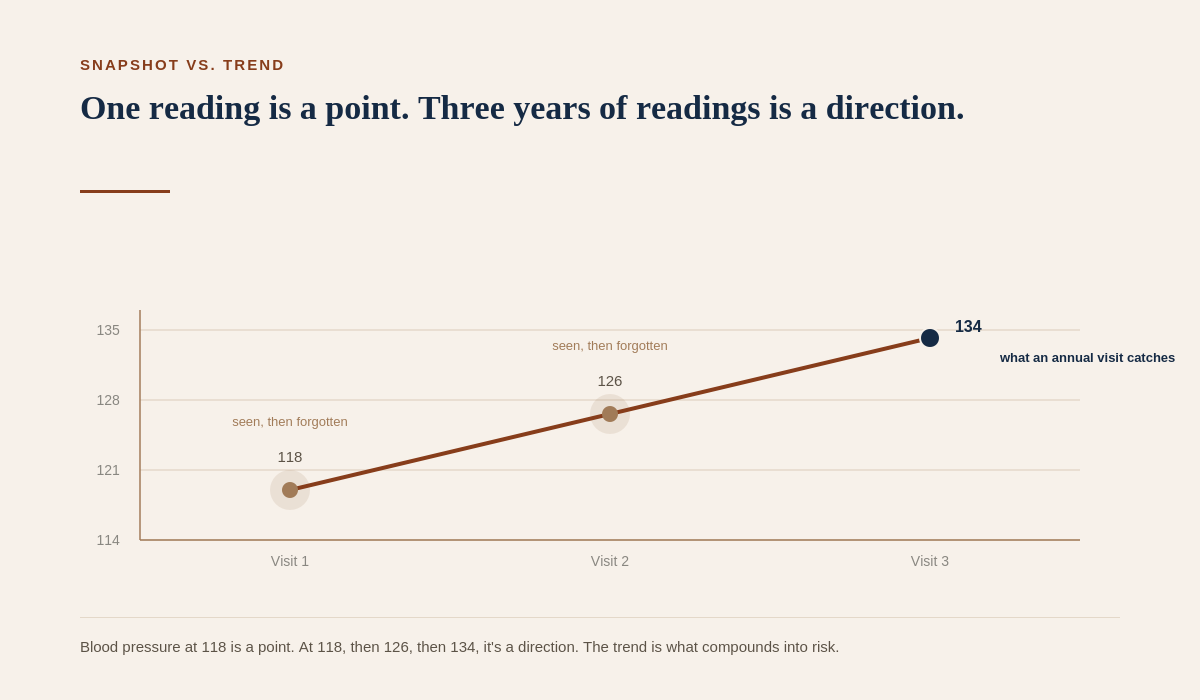
A physician who holds your baseline can see the slope and act on it: adjust medication, tighten a screen, change a referral. We establish each member's baseline across comprehensive diagnostics before the first appointment, then measure every new result against the history we built with you.
What Happens When You Track Your Health Alone?
The wellness industry earns revenue by manufacturing novelty. Podcasts debut a new threat or compound every week, and listeners turn a detailed protocol into a purchase and a morning routine. Wearables reveal your deep sleep and REM. Longevity guests cite a molecule that extended lifespan in mice, and the audience buys it from an online vendor.
All that data has no interpreter. A stack built for a podcast host can raise your liver enzymes or clash with a prescribed medication, because your body metabolizes compounds through pathways unique to you. We protect members by pairing the trends with judgment. Our physicians review the claims you hear, run baseline diagnostics against your metabolic profile, and tell you what to try and what to skip.
How Often Should You Check In After 40?
Through your thirties, one well-built annual visit can cover the bases if you are otherwise healthy. Your forties and fifties change the risk landscape. Cardiovascular risk compounds, metabolic rates shift, hormones reshape energy and sleep, and cancer screening timelines become active. A physician with two or three visits a year and years of your context catches those shifts early. One visit a year leaves the movement unseen.
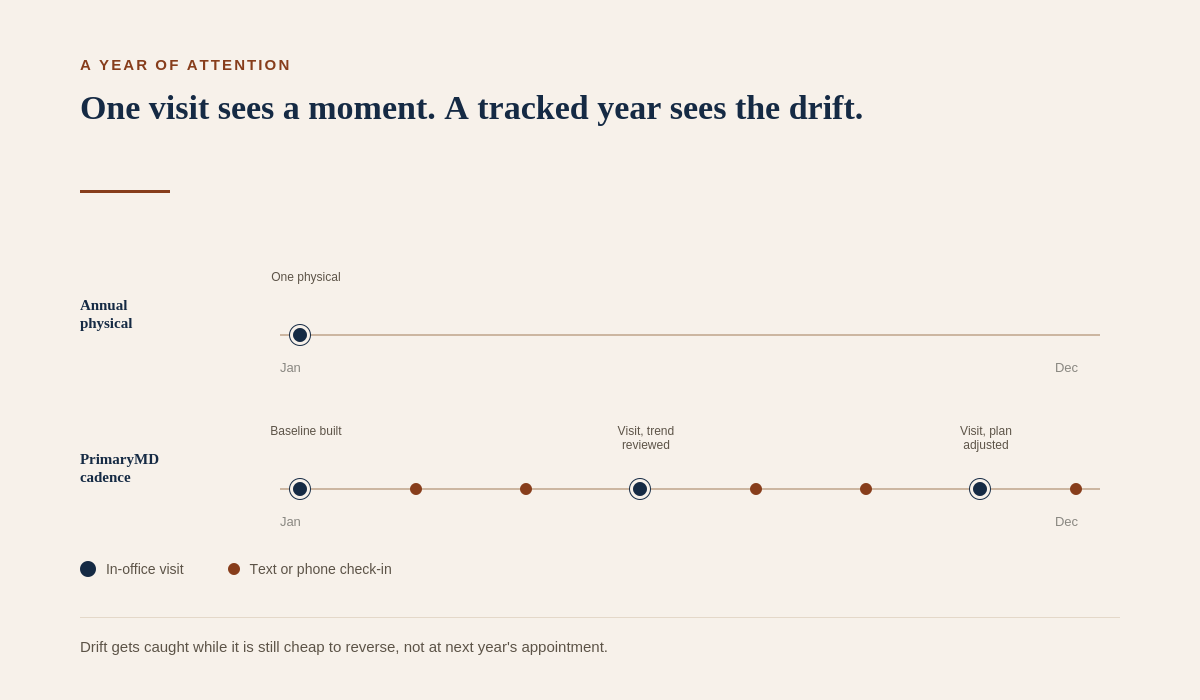
At PrimaryMD, we set each member's cadence from their individual profile rather than a fixed rule. For members on statins, blood thinners, thyroid medication, or immunosuppressants, that cadence is shaped by monitoring requirements: lab values checked, dosages adjusted, side effects assessed. Renewing a prescription without that review leaves the drug unmanaged, and we treat the monitoring as the care itself. We stay engaged between visits by text and phone so questions do not wait for a calendar slot.
What Should a Real Preventive Visit Cover?
A useful preventive visit goes past a blood pressure cuff and a basic panel. It reviews your vitals against the history we built with you. It reads a comprehensive metabolic and lipid panel, thyroid function, glucose, and markers tied to your risk. It updates age-appropriate cancer screening and cardiovascular evaluation. It reviews every medication for whether it is still indicated. It treats sleep, stress, alcohol, and mental health as the clinical conversation they are. It updates family history and plans the year ahead. Covering all of that takes time, and that time is the minimum for prevention to mean anything.
Who Benefits, and What This Model Does Not Replace?
Our model is membership primary care with a small patient panel. Your physician builds your baseline across comprehensive diagnostics before the first visit, sets your visit cadence from your individual profile rather than a fixed rule, monitors you between visits by text and phone, and coordinates your specialists so the plan stays coherent. That is the care relationship this section refers to.
It fits executives in their 40s and 50s whose risk is drifting faster than an annual visit catches, members on statins, blood thinners, thyroid medication, or immunosuppressants that need active monitoring, and anyone who wants a physician in the loop between visits rather than once a year. It does not fit people who want a single physical and no further contact, or who expect us to approve every test or prescription they request. Good medicine means saying no to an antibiotic, an image, or a hormone therapy that lacks an indication. We treat that restraint as a sign of care.
Membership does not replace health insurance, hospital care, or emergency treatment. Those remain separate. A one-time executive physical produces a report. Ongoing care produces a trajectory, and that is the product we deliver.
Frequently Asked Questions
Does a PrimaryMD membership replace my health insurance?
No. Membership covers the primary care relationship and between-visit access. It does not replace hospital care, emergency treatment, or specialist insurance, and those are billed separately.
Can I reach my doctor between visits?
Yes. Members reach their physician by text and phone, so new symptoms, medication questions, and post-specialist follow-up do not wait for a scheduled appointment.
What if my lab result is "normal" but I feel off?
A population-normal value can still be high for you. Because we track your baseline across visits, we can see when a result has drifted against your own history and act on the trend rather than the label.
How do you handle specialist referrals?
Your physician briefs the specialist on your history, reviews their recommendations in context, and follows up to confirm the plan is implemented. That closed loop is the difference between a referral that lands and one that disappears.