
Laboratory VO₂ max testing and wearable estimates can produce different results because they measure or calculate fitness in different ways. Understanding those differences helps you decide which number is useful for the question you are trying to answer.
Key takeaways
- A laboratory test measures oxygen rate of use directly, while a wearable estimates VO₂ max from heart rate, movement, pace, and personal data.
- Differences can reflect exercise mode, effort, recovery, body weight, medication, device settings, environmental factors that affect heart rate, or laboratory methods.
- Wearables help track fitness trends; laboratory testing is better for precise baselines, unexplained exercise intolerance, or structured training decisions.
- At PrimaryMD, our physician and exercise physiologist interpret both types of data alongside symptoms, medical history, medications, training, and recovery. Our exercise physiologist helps translate appropriate findings into practical guidance.
What does VO₂ max actually measure?
VO₂ max describes the maximum rate at which the body can take in, transport, and use oxygen during intense exercise. It is commonly reported in milliliters of oxygen per kilogram of body weight per minute, or mL/kg/min. The number reflects the integrated work of the lungs, heart, circulation, blood, exercising muscles, and the effort a person can sustain. It is not a complete description of health, and it does not diagnose the reason someone may feel short of breath or fatigued, though it can help guide the evaluation.
What happens during a laboratory VO₂ max test?
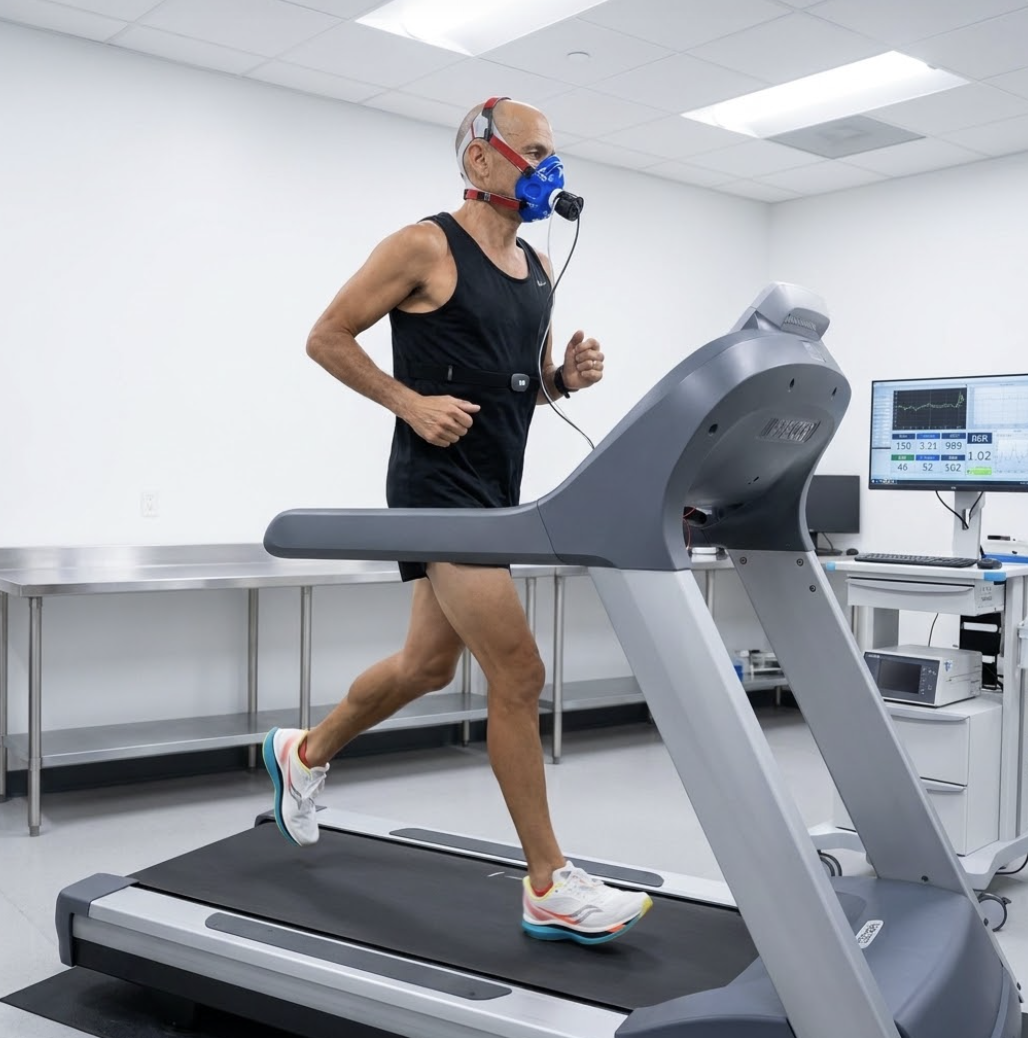
In a laboratory VO₂ max test, you exercise on a treadmill or stationary bike while the workload increases under a defined protocol based on your current activity level, age, and goals. You breathe through a mouthpiece or mask connected to a metabolic system that analyzes the oxygen you inhale and the carbon dioxide you exhale. The test can also record heart rate, blood pressure, ventilation, workload, rating of perceived exertion, respiratory exchange ratio, and recovery. In a clinical diagnostic setting, it may also include ECG monitoring to assess heart rhythm.
What can a laboratory report show beyond the headline number?
A laboratory report may include peak oxygen uptake, ventilatory thresholds, breathing efficiency, heart-rate response, blood-pressure response, and the reason exercise ended. A physician or qualified exercise physiologist can use the pattern to ask whether the limitation appears cardiovascular, pulmonary, muscular, conditioning-related, medication-related, nutrition-related, training-related, or related to how the test was performed.
How do watches estimate VO₂ max?
A wearable usually does not measure the oxygen in your breath. It estimates VO₂ max through an algorithm that combines signals collected during exercise with information in your health profile. Apple, for example, says Apple Watch uses heart and motion sensors during outdoor walking, running, or hiking workouts and also considers age, sex, weight, height, and medications that may affect heart rate. Indoor workouts do not count toward its cardio-fitness estimate. Apple’s explanation of its cardio-fitness estimate illustrates why a watch value is an estimate rather than a direct laboratory measurement. At PrimaryMD, we treat the estimate as a signal to interpret alongside the member’s history and goals, not as a standalone clinical conclusion.
Why do different devices produce different VO₂ max estimates?
Different devices use different sensors, algorithms, activity requirements, and update rules. Some rely heavily on the relationship between pace and heart rate. Others incorporate elevation, GPS, motion, resting data, training history, or a proprietary model. The device may then smooth several observations into a trend rather than presenting a value from one maximal effort. A watch can therefore be useful without being interchangeable with a metabolic cart.
What can cause distortions in a watch estimate?
The estimate is conditional on the data the device receives. A loose fit, an irregular heart-rate signal, incomplete profile information, poor GPS, an unusual route, or a workout that does not resemble the activity used by the algorithm can affect the output. A watch may be answering, "What VO₂ max is most consistent with these recorded signals?" A lab test is answering, "What happened to oxygen consumption and related physiology under this protocol?" Those are related questions, but they are not identical.
Why can a lab result and a watch estimate disagree?
A lab and a wearable use different methods, exercise protocols, and assumptions. A lab measures gas exchange directly, while a watch estimates VO₂ max from heart rate, pace, movement, and profile data. The result can also change with exercise mode, effort, sleep, recovery, medication, body weight, and testing conditions. Research shows that wearable estimates can still have substantial individual-level error. These numbers should be compared carefully rather than treated as interchangeable.
How does exercise protocol affect the comparison?
A treadmill test, cycle test, outdoor run, hilly walk, or swim can place different demands on the body. A person may record a different VO₂ value on a bike than on a treadmill because cycling uses less active muscle mass than running, or because the person is more practiced in one activity than another. Swimming can also produce different responses because body position and water pressure affect blood return, cardiac output, and heart rate. A watch may estimate VO₂ max from an outdoor run while the lab measures cycling, so the numbers can differ because the exercise mode differs, not because one test failed.
How do effort and recovery conditions affect the estimate?
A laboratory result depends on whether you reached the intended intensity and whether symptoms, motivation, unfamiliar equipment, or local muscle fatigue stopped the test. A properly run lab test also uses calibrated equipment that accounts for barometric pressure, humidity, room temperature, and oxygen concentration in room air. A wearable estimate may be influenced by one unusually hot workout, poor sleep, dehydration, illness, altitude, accumulated fatigue, or a heart-rate response altered by medication. A single low watch value after a difficult week may reflect the conditions of that workout more than a lasting change in aerobic capacity.
How do body weight and laboratory methods affect the number?
Relative VO₂ max is oxygen uptake adjusted for body mass, usually reported as mL/kg/min. That adjustment helps compare people of different sizes and place results against age- and sex-based norms. Absolute VO₂, reported in liters per minute, reflects total oxygen use and may answer a different question. If body weight changes, the relationship between absolute and relative VO₂ can change: after weight loss, absolute oxygen uptake may be lower, while relative VO₂ may stay similar because it is divided by a lower body mass. A watch with an outdated weight entry may still generate a different estimate from a laboratory report using current measurements. Laboratories are not perfectly identical either. Equipment, calibration, protocol, treadmill or cycle, averaging method, staff instructions, and criteria used to determine a valid peak can all affect the result. If you want to track change, repeating the test under a comparable protocol is more informative than comparing unrelated numbers from different conditions.
Which number should you trust?
Use the number that fits the question. A wearable trend can help you follow changes across similar workouts, especially alongside pace, resting heart rate, sleep, recovery, and how you feel during exercise. Laboratory testing is more useful when you need a precise baseline, are investigating reduced exercise tolerance, or want to understand what limits performance.
At PrimaryMD, we do not treat a watch estimate as a diagnosis or dismiss it because it is not a direct measurement. Our physician asks what changed, whether the change is repeatable, and whether it fits the member’s symptoms, medications, recent illness, training load, and broader health picture. A lab test may be appropriate when it can answer a specific question about symptoms, exercise tolerance, training intensity, or recovery. It may not be appropriate when the only goal is to obtain a more impressive number.
When is laboratory VO₂ max testing worth considering?
Laboratory testing is worth considering when you need more than a general fitness trend - for example, to investigate unexplained exercise intolerance, plan a structured training program, assess recovery after illness, or establish a baseline that will change your next step. The reason for testing should come before the test. A lower result may reflect conditioning, medication, anemia, lung or cardiovascular limitations, musculoskeletal issues, effort, or the testing protocol, so one score cannot explain the cause. At PrimaryMD, our physician decides what question the test should answer, while Heather Milton, MS, translates the findings into practical exercise guidance. New or severe symptoms - especially chest pain, severe shortness of breath, or fainting - require urgent medical care rather than fitness testing.
How should you compare a lab result with a wearable estimate?
Start by recording how each number was produced: the date, exercise type, protocol, duration, terrain, temperature, recent training, sleep, illness, medications, body weight, and whether the effort was maximal. Check that both results use the same units and body-weight calculation. A large difference may make more sense once those details are aligned.
Then look for a pattern. Several comparable workouts showing a gradual change, especially alongside a change in how you feel, deserve attention. One unusual reading after poor sleep, heavy training, heat, or illness may simply need to be repeated under normal conditions. If a lab result is unexpected, review the protocol, effort, test quality, and interpretation before drawing conclusions. The practical question is whether either result changes what you do next. If not, more testing may add noise. If symptoms, exercise safety, training intensity, or a significant change in health are involved, review the results with a physician or qualified exercise physiologist.
How does PrimaryMD use VO₂ max data?
The physician remains accountable for the medical decision. The exercise physiologist helps translate performance data into practical recommendations, while the wearable or laboratory test supplies evidence for that discussion. At PrimaryMD, this hierarchy keeps testing connected to a plan rather than turning the care relationship into a stream of disconnected metrics.
FAQs
How does PrimaryMD interpret a low wearable estimate?
A member’s watch may show a lower estimated VO₂ max after several weeks of poor sleep and reduced activity. Our physician considers whether there are symptoms, a new medication, recent infection, weight change, or another health issue before treating the estimate as a decline in fitness. If the member is well and the pattern resolves as training and recovery normalize, monitoring may be enough. If the change persists or appears alongside exercise intolerance, a laboratory test or further medical evaluation may be reasonable.
Why does a high VO₂ max result not answer every health question?
A strong wearable estimate does not rule out a problem, and a high laboratory VO₂ max does not answer every question about blood pressure, rhythm, breathing, movement, recovery, or long-term risk. Our goal is not to collect the most data. It is to decide which information matters, explain what it means, and remain accountable for what happens next.FAQs
Is a laboratory VO₂ max test more accurate than a smartwatch estimate?
Usually, yes, when the lab uses a valid cardiopulmonary exercise protocol and directly measures respiratory gases. A smartwatch estimates VO₂ max from heart rate, motion, pace, profile information, and an algorithm. The estimate can be useful for trends, but it should not automatically be treated as interchangeable with a laboratory measurement.
Why is my watch VO₂ max lower than my lab result?
The watch may be estimating from different exercise, conditions, or assumptions. Outdoor pace, heart-rate response, GPS quality, body-weight settings, medication, heat, fatigue, and the difference between cycling and running can all contribute. Compare the test conditions before interpreting the difference as a true decline.
Can a smartwatch diagnose a heart or lung problem?
No. A VO₂ max estimate is not a diagnosis. A persistently low or falling estimate may be worth discussing, especially if it accompanies shortness of breath, chest discomfort, unusual fatigue, dizziness, or a clear decline in exercise tolerance, but symptoms require appropriate medical evaluation.
How often should I get a laboratory VO₂ max test?
There is no universal schedule. Testing is more useful when it answers a specific clinical or training question and the result will change the plan. Repeating a test too often can create noise, especially when protocols, equipment, effort, or recovery conditions differ.
How does PrimaryMD interpret wearable and VO₂ max data?
Our physician reviews the data with the member’s symptoms, history, medications, training, recovery, and goals. When appropriate, our exercise physiologist translates laboratory findings and wearable trends into an exercise recommendation. The next step may be training, monitoring, repeat testing, medical evaluation, or no further action.