

Key Takeaways
- There is no universal panel for everyone over 40. A useful assessment combines routine screening with your anatomy, family history, prior results, medications, symptoms, and exposures.
- Several milestones cluster in midlife: mammography begins at 40 for many average-risk women, colorectal screening at 45, and shingles and pneumococcal vaccination at 50 for most adults.
- Tests like ApoB, Lp(a), coronary calcium scoring, DEXA, sleep studies, and VO₂ max add real value when the result could change a decision. Ordered as a default package, they mostly add cost and incidental findings.
- At PrimaryMD, we start with the clinical question, select the tests that fit the member, and give every meaningful finding one of five next steps: act, monitor, repeat, refer, or leave alone.
A "full checkup after 40" is a marketing category, not a medical one. Two people the same age can need completely different workups. Screening depends on far more than a birthday.
A strong plan starts by reviewing:
- Personal and family history, new symptoms, and changes in function
- Prior lab results, imaging, procedures, and screening records
- Current medications, supplements, vital signs, and weight trajectory
- Tobacco, alcohol, occupational, travel, and environmental exposures
- Sleep, exercise, nutrition, stress, mental health, and reproductive history
- Which preventive services are due, overdue, or no longer appropriate
The USPSTF A and B recommendations are a solid evidence-based starting point. They are population-level, though. Your family history, prior findings, or specialty guidelines can all shift the right starting age or interval for you specifically.
A useful assessment also tells you what was left out and who will follow up on the results.
Which Core Checks Are Worth Prioritizing After 40?
The foundation is less exciting than most direct-to-consumer packages. It also carries considerably more proven value.
The 2026 ACC/AHA dyslipidemia guideline adds useful structure to the cardiovascular piece. It recommends estimating absolute risk using the PREVENT equations for adults 30 to 79. Lp(a) should be measured at least once in adulthood. ApoB and coronary calcium scoring are selective tools, useful when standard information leaves the decision unsettled.
Which Milestones Change in Your 40s, 50s, and 60s?
Treat these as checkpoints, not a checklist. Each one opens a conversation about your own risk.
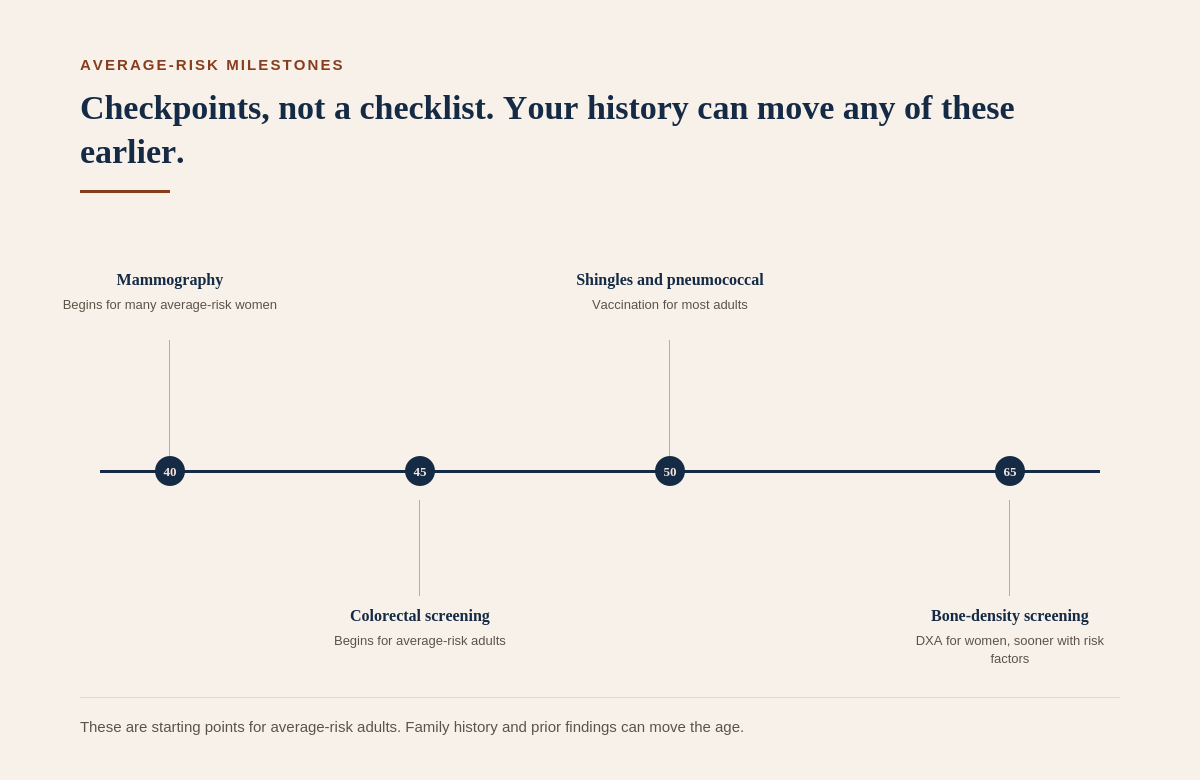
For average-risk women, the USPSTF recommends mammography every other year from 40 through 74. Colorectal screening begins at 45 for average-risk adults. Options include stool-based tests and colonoscopy.
Lung cancer screening uses annual low-dose CT. It applies to adults 50 to 80 with a 20 pack-year history who currently smoke or quit within the past 15 years. It does not apply to everyone.
For bone density, the January 2025 USPSTF osteoporosis recommendation supports DXA screening for women 65 and older. Postmenopausal women under 65 qualify when a clinical risk tool confirms at least one risk factor, such as low body weight, parental history of hip fracture, smoking, or excess alcohol use. For men, the evidence is insufficient either way. That puts more weight on individual risk. Among US adults 65 and older, osteoporosis affects roughly 27% of women and under 6% of men.
The CDC adult immunization schedule should be checked against your record, conditions, travel, and exposures. Shingles and pneumococcal vaccination are recommended for most adults beginning at 50, and earlier on a risk basis.
Which Additional Tests May Be Worth Ordering?
Additional testing is most useful when a standard assessment leaves an important question open and the result could change the care plan.
- Lp(a) and ApoB: Lp(a) may be measured once in adulthood, while ApoB can clarify particle-related cardiovascular risk. Repeating broad lipid testing without a specific decision in mind is usually low-value.
- Coronary artery calcium CT: This may help when cardiovascular risk is near a treatment threshold and the result could change management. It should not become a routine annual test or replace control of established risk factors.
- DEXA: A DEXA scan may be appropriate when osteoporosis criteria are met, fracture risk is elevated, or body-composition data will guide a specific plan. Repeating it simply because the number is interesting adds little value.
- Sleep study: A sleep study can help evaluate possible obstructive sleep apnea when symptoms or risk factors are present. Routine screening of asymptomatic adults without a clinical question is unlikely to be useful.
- Genetic counseling or testing: This may be appropriate when personal or family history suggests an inherited condition. A genetic variant should not automatically be treated as a diagnosis.
- VO₂ max and grip-strength testing: These tests can establish a useful baseline or inform an exercise prescription. Performance data should support health and training decisions rather than be presented as disease screening.
- Targeted imaging: Imaging is most useful when symptoms, an examination, or prior findings raise a specific question. Broad imaging performed simply because it feels thorough can create incidental findings without improving care.
Which Popular Tests Should Not Be Automatic After 40?
Midlife brings increased marketing for broad scans, cancer-detection blood tests, hormone packages, genetic panels, and continuous monitoring. Some may be appropriate in specific situations, but none replaces established preventive care.
Full-body MRI: The American College of Radiology does not support routine total-body MRI for people without symptoms, relevant risk factors, or a suggestive family history. Incidental findings can lead to unnecessary follow-up, cost, and anxiety. In selected cases, such as a known hereditary risk, it may be worth discussing with a physician. It does not replace mammography, colorectal cancer screening, cervical screening, or low-dose lung CT for eligible smokers.
Multi-cancer early detection tests: These blood tests are promising, but their role in screening people without symptoms remains uncertain. The National Cancer Institute notes that more research is needed to determine whether their benefits outweigh their harms. A positive result may lead to imaging, biopsies, and uncertainty, while a negative result does not replace established screening or evaluation of symptoms.
Broad hormone, nutrient, and genetic panels: Testing is more useful when symptoms, medications, diet, or family history raise a specific clinical question. Otherwise, abnormal or uncertain findings may lead to unnecessary treatment. A physician who recommends against a test is applying clinical judgment: if the result is unlikely to change care or has no validated follow-up, declining it may be the most appropriate decision.
What Should Happen After the Results Come Back?
Getting results back is not the finish line. Every meaningful finding needs a defined next step.
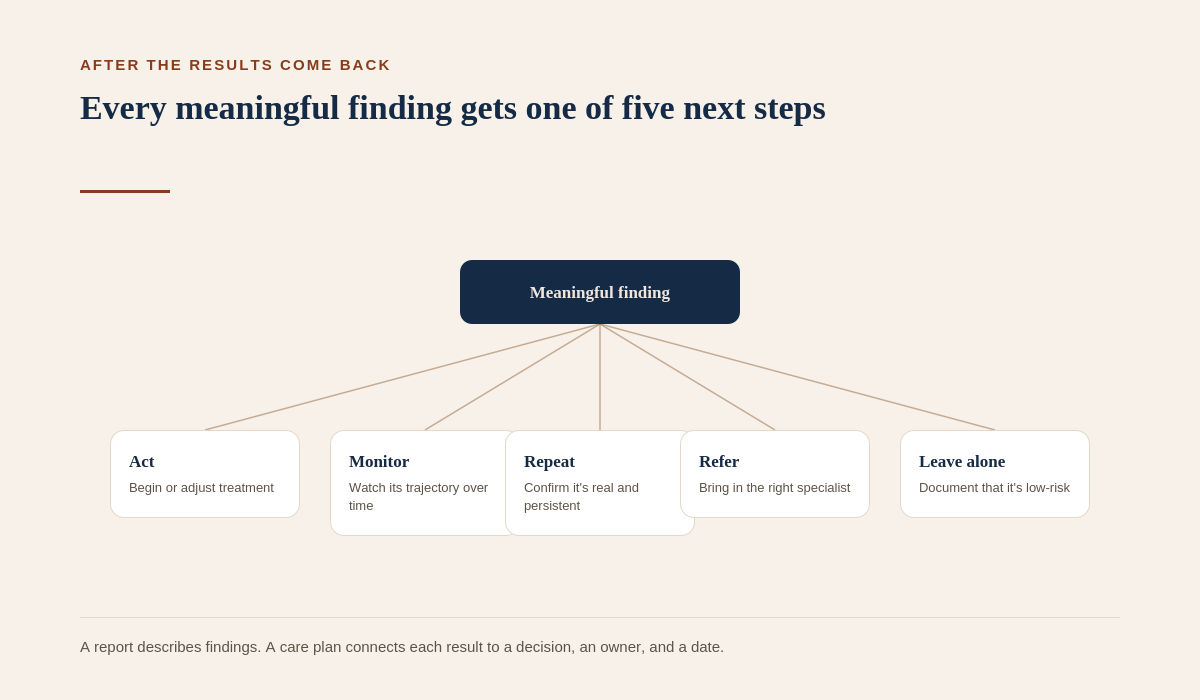
A test result can lead to several different next steps:
- Act: Begin or adjust treatment or prevention. For example, confirmed hypertension may lead to home monitoring and medication.
- Monitor: Keep the finding in the care plan and track its trajectory. A borderline marker may be reviewed alongside other risk factors.
- Repeat: Recheck the result to confirm that it is persistent before taking action.
- Refer: Involve the appropriate specialist when an imaging, genetic, or other finding requires expertise beyond primary care.
- Leave alone: Document a low-risk finding without creating unnecessary follow-up. This may be appropriate for a benign incidental result.
The plan should name who owns each item and when it gets revisited. What needs attention now? What gets watched over 90 days? What is followed over years?
A report describes findings. A care plan connects each result to a decision, an owner, and a date.
How We Build a Health Assessment at PrimaryMD
We begin with your records, medications, specialist notes, imaging, family history, and current concerns. That review helps identify gaps, duplicated testing, and risks that deserve attention before we choose a baseline.
Testing is tailored to the clinical question and may include bloodwork, DEXA, VO₂ max, metabolic testing, grip strength, wearable data, genomic information, or targeted imaging. The physician-led team then places meaningful findings into one of five paths: act, monitor, repeat, refer, or leave alone. Through membership, quarterly physician reviews, repeat bloodwork, coaching, and exercise-physiology guidance keep the plan current. Our approach to bloodwork and diagnostics follows the same principle: information becomes useful when it informs a decision and someone remains accountable for what happens next.
Membership does not replace health insurance, hospital care, specialist fees, procedures, or emergency services. If you have an emergency, call 911.
So, What Tests Should You Get After 40?
The best health assessment is the one that leads to better decisions. Testing should reflect current evidence, personal risk, and a clear plan for what happens next.
When comparing assessments, ask: What could each test change? What would the practice advise against? Who reviews the results? And who remains responsible after the report? The answers reveal whether you are receiving a care plan or simply more testing.
Frequently Asked Questions
What blood tests should you get after 40?
There is no universal panel. Depending on your history, common starting points may include cholesterol, glucose regulation, blood counts, kidney and liver function, and any tests suggested by your symptoms, medications, or risk factors. Lp(a) should generally be measured at least once in adulthood, while ApoB and other markers are more selective.
What cancer screenings should start after 40?
For many average-risk women, mammography begins at 40. Colorectal cancer screening generally begins at 45. Cervical screening continues through 65 when applicable, provided prior screening has been adequate and no high-risk factors are present. Lung cancer screening applies only to adults who meet age and smoking-history criteria. PSA screening between 55 and 69 is an individual decision based on risk, potential benefits, harms, and personal preferences.
Should you get a DEXA scan at 40?
Not automatically for osteoporosis screening. A DEXA may be appropriate earlier when menopause, fracture history, low body weight, steroid exposure, or a formal risk assessment indicates elevated fracture risk. Body-composition DEXA is a separate use and belongs in the plan only when the result will change an exercise, nutrition, or muscle-preservation decision.
Is an annual physical enough after 40?
It can be, if the visit includes a meaningful review of your records, risk factors, symptoms, preventive screening, mental health, and abnormal results. The label “annual physical” guarantees none of that. Ask what was reviewed, which preventive services are due, and who will follow up on the results.
How often should a health assessment be repeated?
Most tests do not need to be repeated annually. The appropriate interval depends on the finding, treatment, risk level, test reliability, and whether a repeat could change care. A good plan records the reason and timing for each repeat.
Do you need a full-body MRI after 40?
Not routinely. The American College of Radiology does not recommend total-body MRI for people without symptoms, relevant risk factors, or a suggestive family history. Incidental findings can lead to unnecessary follow-up, expense, and anxiety. Targeted imaging may be appropriate when symptoms, examination findings, prior results, or inherited risk raise a specific clinical question.