

Key Takeaways
- Whole-genome sequencing reads all of your DNA, but only a fraction of variants carry established clinical meaning, and it earns its value when a physician ties those findings to your personal and family history.
- A known, actionable variant can reshape screening intervals, medication decisions, or specialist referrals; a result of uncertain significance may change nothing in the near term.
- Privacy protections vary by insurer and state, so know how your data is stored and who can access it, and expect your physician to facilitate genetic counseling rather than leave you reading the report alone.
- At PrimaryMD, whole-genome sequencing is part of the membership, and your physician interprets it alongside your full clinical picture.
What Can Whole-Genome Sequencing Reveal?
Whole-genome sequencing reads the roughly three billion base pairs that make up your DNA. That is a different scope than targeted genetic panels, which examine specific genes already associated with particular conditions, or consumer ancestry tests, which look at a narrow set of common variants.
A clinical whole-genome sequence can identify:
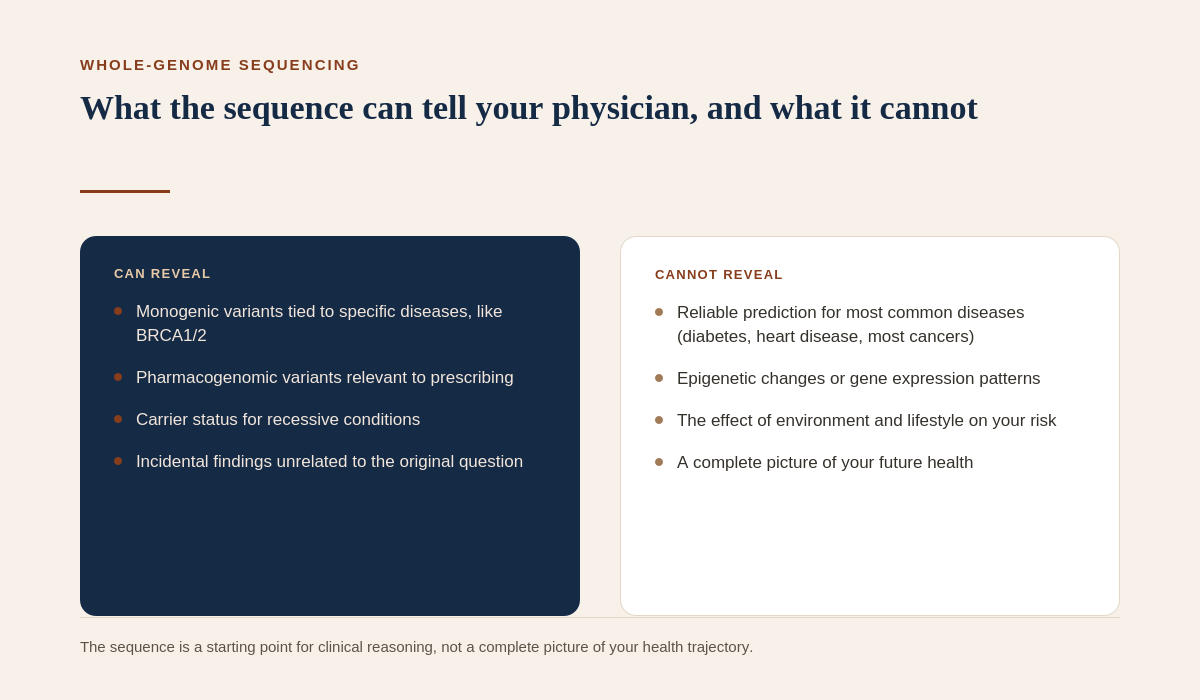
- Monogenic variants: Mutations in a single gene with well-established links to disease risk, such as variants in BRCA1 or BRCA2 associated with hereditary breast and ovarian cancer, or variants linked to hereditary cardiac conditions.
- Pharmacogenomic variants: Differences in genes involved in drug metabolism that may be relevant to prescribing considerations for certain drug classes. These findings require clinical interpretation and do not independently determine medication selection.
- Carrier status: Whether you carry a recessive variant that could be relevant for family planning.
- Incidental findings: Variants in genes unrelated to your original clinical question that may still carry medical significance.
What It Does Not Reveal
Whole-genome sequencing does not predict most common diseases. Conditions like type 2 diabetes, coronary artery disease, and many cancers involve hundreds of genetic variants interacting with lifestyle, environment, and chance. No genome report can reliably tell you whether you will develop these conditions, and no credible physician should frame it that way.
The sequence also does not capture everything relevant to your health. Epigenetic changes, gene expression patterns, and environmental exposures sit outside what a sequence alone can show. The result is a starting point for clinical reasoning, not a complete picture of your health trajectory.
When Might It Help a Healthy Adult?
For most healthy adults, a whole-genome sequence will not produce findings that change clinical management. That is not a flaw in the technology. It reflects the current state of genomic science: the variants we understand well enough to act on represent a small fraction of what the sequence returns.
That said, there are specific situations where sequencing can genuinely add value.
Strong Family History of a Heritable Condition
If a first-degree relative was diagnosed with hereditary breast or ovarian cancer, a hereditary cardiac arrhythmia, Lynch syndrome, or another condition with a known genetic basis, sequencing can clarify whether you carry the relevant variant. A positive finding may inform surveillance frequency, preventive interventions, and specialist referrals, though the clinical pathway depends on the specific variant, its penetrance, and your broader history. A result that does not identify the variant in question can be informative, but its interpretation still requires discussion with your physician and, in many cases, a genetic counselor.
Medication Planning
If you take or are considering medications with known pharmacogenomic associations, your physician may find metabolizer status relevant to the prescribing conversation. This is not a guarantee of a different medication or dose. It is one input among others, including clinical response, tolerability, and your full medication history. Some drug classes where pharmacogenomic data is more established include certain antidepressants, anticoagulants, and pain medications, though the clinical weight of that data varies by drug and by individual.
Unexplained Symptoms or an Inconclusive Workup
When a clinical picture does not resolve through standard evaluation, sequencing can surface variants that explain findings that were otherwise unclear. This applies less often to healthy adults but is worth considering when prior workup has been unrevealing.
Baseline for Long-Term Care
Some physicians include sequencing early in a care relationship so that results are already integrated when clinical questions arise later. The genome does not change. The clinical questions that make specific variants relevant will evolve over time, and having the data on record means you are not starting from scratch when they do.
When May It Not Change Your Care?
Sequencing is often positioned as a comprehensive answer. In practice, whole-genome sequencing may identify variants of uncertain significance (VUS): variants whose clinical meaning is not yet established and which generally should not independently guide medical decisions. A VUS is not a diagnosis. It is not a risk factor you can act on. It is a data point that requires monitoring as the research evolves.
For a healthy adult with no family history of a heritable condition and no unexplained clinical findings, a genome sequence may return:
- Variants of uncertain significance that cannot be interpreted clinically at this time
- Carrier status for recessive conditions that are only relevant if both parents carry the same variant
- Polygenic risk scores for common diseases that do not meaningfully refine the risk already estimated from your family history and biomarkers
The honest framing: A report that returns only VUS or carrier status does not mean the test failed. It means your genome, at this point in scientific understanding, does not contain variants that change your care plan. Delivered in the right clinical context, that is genuinely useful information.
The risk of sequencing without that context is not the test itself. It is the anxiety that can follow an unexplained result, and the downstream cascade of follow-up testing that may not be warranted. A physician who orders a genome needs to be prepared to sit with you through that conversation, not hand you a PDF and move on.
Why Results Need Family History and Clinical Context
A genome sequence is not self-interpreting. The same variant can carry very different implications depending on who carries it and what else is true about them clinically.
Consider a variant associated with elevated cardiovascular risk. In a 45-year-old with a strong paternal history of early heart disease, elevated LDL on recent labs, and a sedentary lifestyle, that variant adds meaningful weight to an already concerning picture. In a 45-year-old with no family history, optimal biomarkers, and high cardiorespiratory fitness, the same variant may not change the clinical recommendation at all.
This is why family history is not a formality. At PrimaryMD, genetic findings are considered alongside your family history, biomarkers, and the broader clinical picture. That context shapes how variants are weighted, which findings merit closer attention, and when specialist referral or genetic counseling is appropriate.
The Role of Genetic Counseling
For findings that carry significant implications, particularly variants associated with hereditary cancer syndromes or cardiac conditions, genetic counseling adds a layer of interpretation that goes beyond a standard physician visit. A certified genetic counselor can help you understand the penetrance of a variant (how likely it is to cause disease), the implications for biological relatives, and the decisions that follow from a confirmed result.
Not every genetic finding requires formal genetic counseling. But a practice that offers whole-genome sequencing should have a clear process for facilitating that referral when it is warranted. Leaving a patient to navigate a significant finding independently is not a clinical standard worth accepting.
What Happens After a Result?
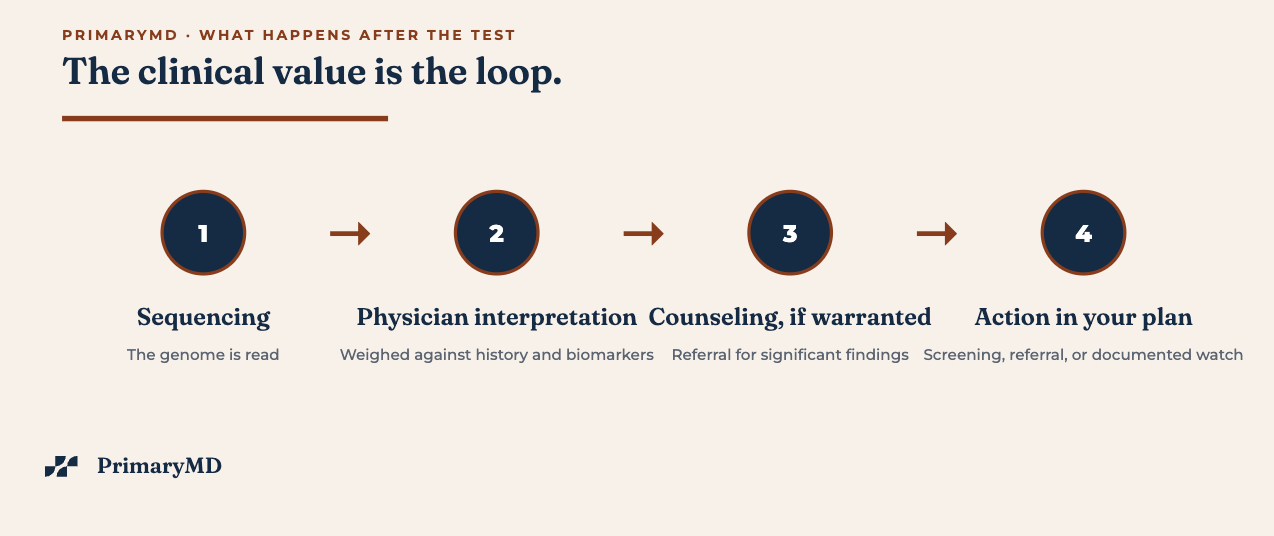
The clinical value of whole-genome sequencing is not in the report. It is in what happens after.
A result that identifies an actionable variant should trigger a specific clinical response: adjusted screening intervals, a specialist referral, a medication change, or a documented decision to monitor and reassess. Ask how the practice documents genetic findings and whether its care team revisits them when new clinical questions arise. For more on how PrimaryMD approaches follow-through, see our article on How Closed-Loop Care Works.
Inadequate follow-through has a recognizable shape: a PDF delivered through a portal, a brief note that "no significant findings were identified," and no scheduled conversation. That outcome is not unique to direct-to-consumer tests. It happens in concierge settings too.
The question to ask any practice is not whether they offer whole-genome sequencing. It is what they do with the results.
Privacy and Data Considerations
Your genome is the most personally identifying data that exists. It does not change over your lifetime, and it carries information about biological relatives who did not consent to testing. Before sequencing, it is worth understanding exactly how your data will be handled.
Key questions to ask any practice or laboratory:
- Storage: Where is your genomic data stored, and for how long? Is it retained by the sequencing laboratory, the practice, or both?
- Secondary use: Can your de-identified data be used for research? If so, can you opt out?
- Third-party access: Under what circumstances, if any, could your data be shared with insurers, employers, or law enforcement?
- Security: What protections are in place against data breaches?
Federal Protections and Their Limits
The Genetic Information Nondiscrimination Act (GINA) prohibits health insurers and employers from discriminating based on genetic information. However, GINA does not cover life insurance, disability insurance, or long-term care insurance. If you are in the process of obtaining coverage in any of those categories, the timing of genetic testing is worth discussing with your physician before you proceed.
Some states have enacted additional protections that go beyond GINA. Your physician should be able to outline what applies in your state or refer you to an appropriate resource.
At PrimaryMD, genetic data is handled through clinical-grade laboratory partners with defined data governance policies. Your physician can walk you through those specifics before you decide to test.
How to Evaluate Concierge Practices That Offer Sequencing
Whether a practice offers whole-genome sequencing says little about whether it can use it well. The difference lives in the process - a practice that uses it well has a physician reviewing and interpreting results, a clear path to genetic counseling or specialist referral when a finding calls for it, and a care plan that documents findings and revisits them over time. It tells you plainly when sequencing is unlikely to change your care, and it explains variants of uncertain significance instead of burying them in a report. On data governance, it lets you request deletion of your genomic data and shows you how.
Three questions to help you evaluate, ask:
- What happens when a genome returns a variant of uncertain significance: a strong answer names a specific follow-up, while a vague one about who reviews it and when is a warning.
- How much time is allocated to discuss results, because a brief portal message is not a results conversation and a scheduled visit with your physician is.
- Which laboratory performs the sequencing and what their data retention policies are, since a practice confident in its process answers without hesitation.
At PrimaryMD, sequencing sits alongside 100 biomarkers, body composition analysis, and cardiorespiratory fitness assessment. It informs the plan. For a broader look at how these inputs fit together, see Dr. Takhar on Precision Medicine Made Simple.
In Summary
Whole-genome sequencing is a meaningful clinical tool in the right hands and the right context. At PrimaryMD, it belongs to a broader model of care where data serves decisions and physicians stay accountable for both. If you are considering a membership and want to understand whether sequencing makes sense for your situation, learn about membership and speak with a physician directly.
Frequently Asked Questions
Is whole-genome sequencing the same as a consumer DNA test?
No. Consumer tests like ancestry or wellness panels examine a limited set of common variants. Clinical whole-genome sequencing reads your entire genome and is interpreted by a physician in the context of your medical history. The scope, clinical rigor, and follow-through are fundamentally different.
Does whole-genome sequencing tell me if I will get cancer?
Not reliably, for most cancers. A small subset of cancers have known hereditary forms driven by single high-risk variants, such as BRCA1/2 for breast and ovarian cancer. Most cancers are influenced by many genetic variants alongside environmental and lifestyle factors. Sequencing can identify hereditary risk in specific contexts. It cannot predict cancer for the general population.
Is genetic testing covered by insurance?
Coverage varies by insurer, indication, and state. Testing ordered for a specific clinical indication, such as a strong family history of a heritable condition, is more likely to be covered than population-level wellness sequencing. At PrimaryMD, sequencing is included within the membership model. Your physician can advise on any additional cost considerations.
Should I be concerned about what my genome might reveal?
Most whole-genome sequences do not return findings that dramatically alter a care plan. For findings that do carry significant implications, your physician will discuss them with you directly, in context, with a clear plan for next steps. The goal is not to generate anxiety. It is to surface information that is actionable and to interpret everything else appropriately.
How does PrimaryMD use genome results in ongoing care?
Ask how the practice documents genetic findings and whether its care team revisits them when new clinical questions arise. The genome is a fixed document. The clinical questions that make specific variants relevant will evolve, and a physician-led model should be equipped to address them when they do.
Can I share my PrimaryMD genome results with another physician?
Yes. Your genetic data belongs to you. PrimaryMD can provide documentation suitable for sharing with specialists or other providers. Your physician can also facilitate direct coordination when a specialist referral is warranted.