

Personalized nutrition planning supports behavior change and helps you move toward health goals, but it cannot replace diagnosis, medication management, or the medical judgment that makes those goals safe to pursue. Most nutrition content ignores that boundary. For anyone with a chronic condition, medications, metabolic changes, or complex history, eating well alone does not resolve what is actually going on. The outcome changes when a physician who knows your labs, medications, history, and goals decides which adjustments are appropriate, which need monitoring, and which should wait. That is different support than a meal plan.
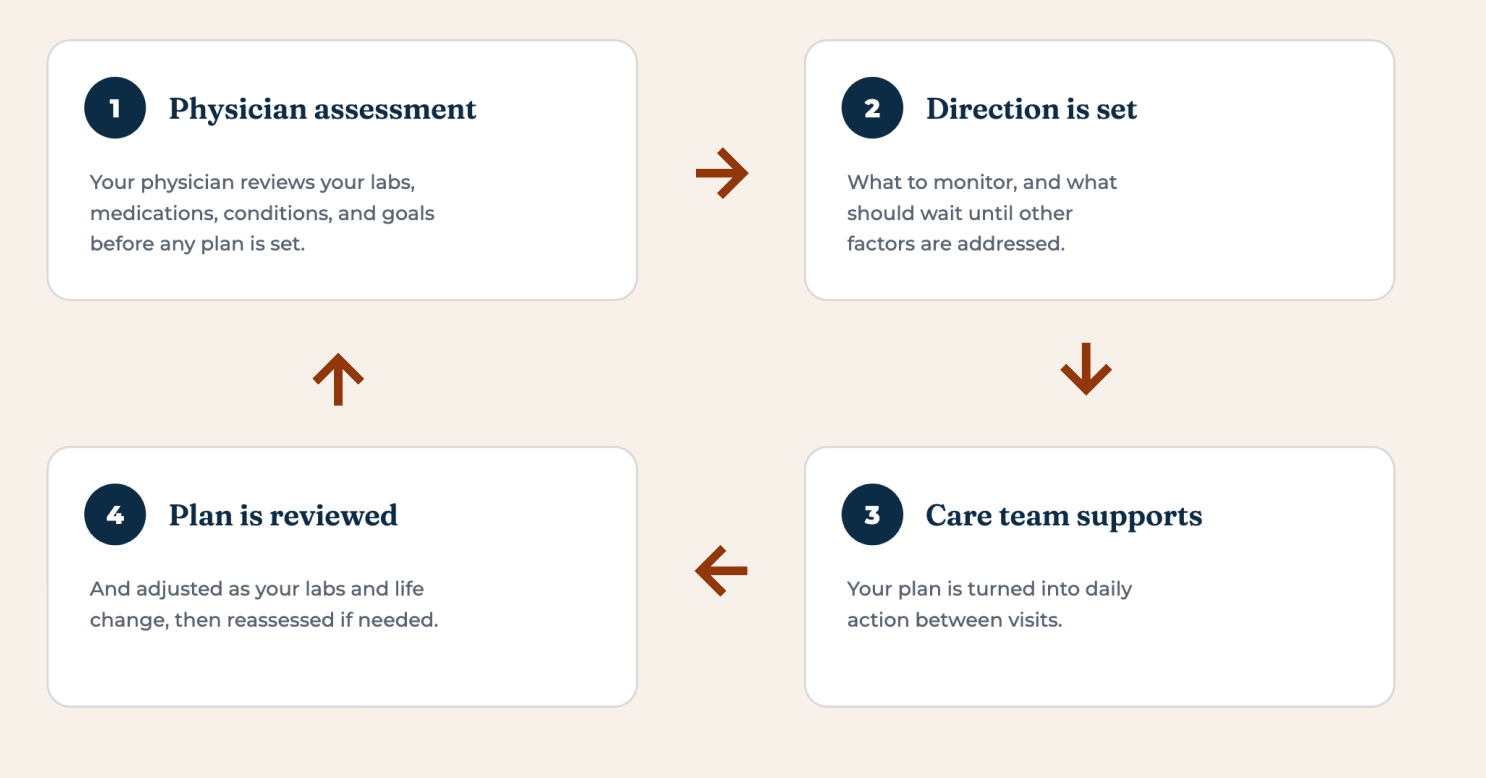
The core idea: Nutrition planning works best as one component of a coordinated medical plan, not as a standalone intervention. The physician sets the direction. The care team helps you follow through.
Key Takeaways
- Personalized nutrition planning can support behavior change, habit formation, and progress toward health goals when it is part of a physician-led plan.
- Nutrition guidance that ignores your medical context can be ineffective or, in some cases, counterproductive.
- Consistency and ongoing review matter more than any single meal plan or initial recommendation.
- At PrimaryMD, personalized nutrition and exercise planning is one component of your overall care plan, not a separate program running in parallel to your medical care. PrimaryMD Membership explains how nutrition planning sits inside the broader membership experience.
What Can Personalized Nutrition Planning Reasonably Help With?
Physician-led nutrition planning may help you apply appropriate recommendations to your daily routines in a way that is grounded in your current medical picture. Knowing what to eat is rarely the obstacle. Changing how you eat, consistently, over months and years, requires a plan built around your actual life, not a generic framework.
Within a physician-led model, personalized nutrition planning can help with:
- Building consistency around eating patterns that align with your medical goals, whether that involves managing blood sugar, supporting cardiovascular health, or addressing dietary factors your physician has identified as relevant to your current health picture
- Navigating practical barriers like travel, work schedules, food preferences, and household dynamics that make general advice difficult to apply
- Reinforcing physician recommendations so that what was discussed in a clinical visit becomes something you can actually act on between appointments
- Tracking relevant patterns in how food choices interact with energy, sleep, symptoms, or lab trends over time
- Adjusting habits incrementally rather than overhauling everything at once, which tends to produce more durable change
What It Is Not
Nutrition planning is not a diagnostic service. It does not interpret labs, adjust medications, or determine whether a symptom is food-related or something that requires clinical evaluation. A sound nutrition plan recognizes those limits and defers to the physician when questions move into clinical territory.
Nutrition planning that operates separately from your labs, your prescriptions, and your physician's current assessment produces recommendations that can be generic at best and contraindicated at worst. The value is in the integration.
When Does Medical Evaluation Matter More Than Nutrition Advice?
There are situations where the right first step is clinical evaluation, not a dietary adjustment. Recognizing those situations is part of what physician judgment provides.
If you are experiencing unexplained weight changes, persistent fatigue, blood sugar instability, elevated lipids, or symptoms that don't resolve with lifestyle modifications, those findings need a medical explanation before they need a meal plan. Acting on nutrition changes without that context can delay a diagnosis, mask a symptom, or conflict with a treatment that's already in progress.
A few examples where medical evaluation comes first:
- Thyroid dysfunction affecting metabolism and energy requires diagnosis and management before nutrition changes will have meaningful impact
- Kidney disease significantly alters what dietary patterns are safe, particularly around protein and potassium intake
- If you take any ongoing medications, your physician should review them before you make significant dietary changes, since some adjustments can affect how medications work or how your body responds to them
- Eating behaviors tied to anxiety, restriction, or disordered patterns warrant clinical assessment, not coaching alone
Having a physician involved before making significant changes matters most when you have an existing condition, take medications, or have labs trending in a concerning direction.The physician determines what is appropriate, what needs monitoring, and what should be addressed through other means first. Nutrition planning follows from that assessment.
How Does Nutrition Fit Within a Physician-Led Care Plan?
At PrimaryMD, personalized nutrition planning is not a separate program you add to your membership. It is one dimension of your overall care, shaped by our physicians based on your full medical picture.
That plan draws on your medical history, current labs, medications, symptoms, lifestyle, and goals and changes as those factors change.
How Your Physician Shapes Nutrition Decisions
Your physician determines which nutritional considerations are clinically relevant for you and which are not. That assessment involves:
- Lab context: Your labs and other clinically relevant health information provide a clinical basis for nutrition conversations that generic advice cannot replicate
- Medication context: When you take ongoing medications, significant dietary changes are worth reviewing with your physician before acting on them, when clinically appropriate.
- Chronic condition management: For conditions like type 2 diabetes, hypertension, or metabolic syndrome, nutrition is a meaningful lever, but it operates alongside, not instead of, medical management
- Specialist coordination: When a cardiologist, endocrinologist, or other specialist is involved in your care, nutrition guidance needs to align with their recommendations, not contradict them
The Care Team's Role
Once the physician has established what is appropriate, the care team supports the broader plan within their defined roles. Your dedicated patient care coordinator handles care coordination, logistics, and clinical workflow, keeping your care organized and continuous. Your exercise physiologist focuses on the physical and fitness dimensions of your plan, working alongside your physician on personalized exercise planning.
Nutrition planning remains a physician-led function. The care team does not extend or interpret it independently.
Why Consistency and Review Matter More Than a One-Time Meal Plan
A one-time meal plan is a document. What actually changes health outcomes is what you do with it, consistently, over time, with someone paying attention.
The most common failure point in nutrition support is not bad advice. It is the absence of follow-through. An initial set of recommendations cannot account for what happens next: the medication that changes your appetite, the lab result that shifts your priorities, the season of life that makes your previous approach impractical. Without ongoing review, even a thoughtful starting point becomes outdated.
What Longitudinal Accountability Looks Like
Effective nutrition support within a medical model involves:
- Regular check-ins that connect eating patterns to current labs, symptoms, and goals, not to a fixed protocol from six months ago
- Plan adjustments when something changes clinically, whether that is a new diagnosis, a medication switch, or a shift in your biomarkers
- Honest assessment of what is working and what is not, without defaulting to more restriction or more supplementation as the default answer
- Continuity across your care team so that your physician, any relevant specialists, and the people supporting your daily habits are all working from the same current picture
The difference between a meal plan and a care plan: A meal plan tells you what to eat. A care plan tells you what is appropriate for you right now, given everything your physician knows about your health, and it changes as you do.
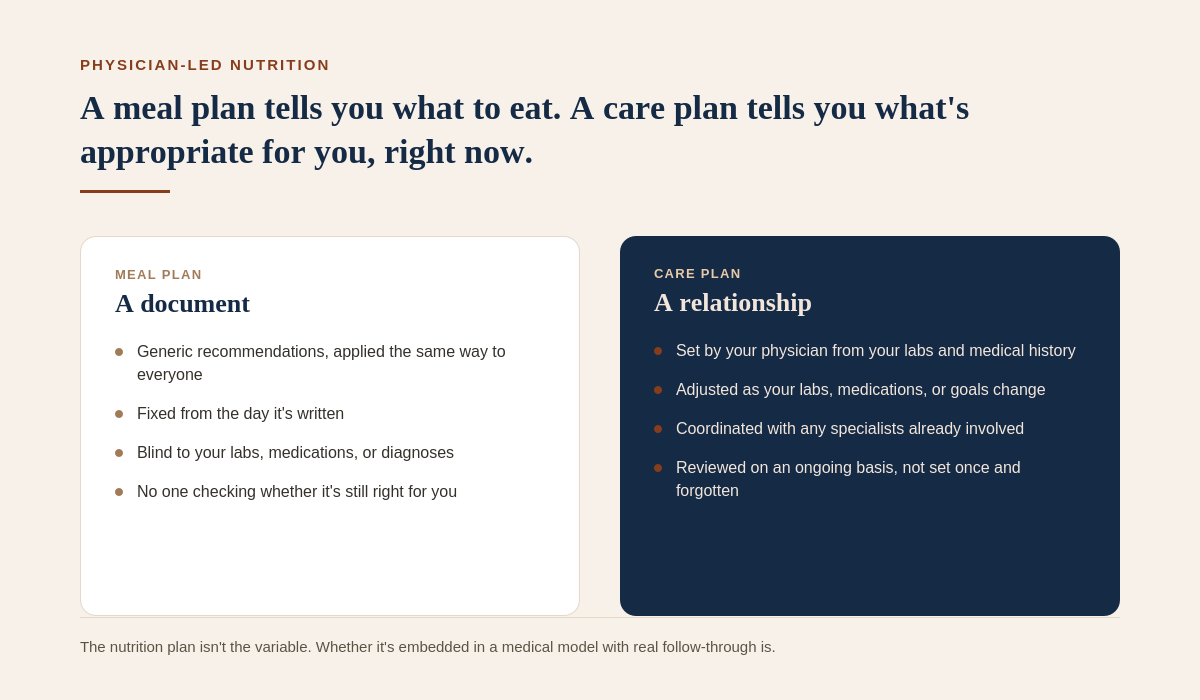
This is why the question "does nutrition coaching improve health outcomes?" does not have a simple yes or no answer. The nutrition plan itself is not the variable. The variable is whether it is embedded in a medical model that has the clinical depth to make the guidance relevant and the follow-through to make it stick.
Frequently Asked Questions
Is nutrition planning included in a PrimaryMD membership?
Personalized nutrition and exercise planning is included in the membership, not a separate add-on. Your physician incorporates it into your overall health plan based on your medical history, labs, and goals. It is not a standalone service, and there is no separate nutrition coach or dietitian role within the PrimaryMD care team.
Do I need to have a health condition to benefit from nutrition support?
No. Nutrition guidance is relevant across a range of goals, from managing a chronic condition to optimizing energy, body composition, or long-term metabolic health. What matters is that the guidance is grounded in your current clinical picture, not a generic framework.
Can nutrition coaching replace a medication I'm currently taking?
That is a clinical question with no general answer. Medication decisions depend on your specific condition, your current labs, your history, and your physician's ongoing assessment. Your physician determines whether and how dietary changes factor into your treatment plan. A nutrition plan does not change medications, and no dietary adjustment should be made with that expectation.
What if I've already worked with a dietitian or nutritionist outside of PrimaryMD?
Prior work with a dietitian or nutritionist can be a useful starting point. At PrimaryMD, your physician reviews that history alongside your labs and medical context to determine what remains appropriate and what may need to be adjusted given your current health picture. Outside nutrition work is treated like any outside specialist input: it gets folded into one plan, not run in parallel.
How often will my nutrition plan be reviewed?
There is no fixed schedule that applies to everyone. Review frequency depends on your goals, any active conditions, and how your labs and symptoms are trending. Your physician determines when a check-in or plan adjustment is warranted.
What if I'm not sure whether a symptom is related to what I'm eating?
That is exactly the kind of question your physician should evaluate. Symptoms that seem food-related may have other causes, and symptoms with other causes are sometimes influenced by diet. A physician-led model ensures that those questions get a clinical answer rather than a nutritional guess.