

Key takeaways
- Heart disease is the leading cause of death among adults in New York City, and risk can develop without obvious symptoms.
- A useful preventive evaluation starts with blood pressure, cholesterol, diabetes risk, family history, lifestyle, and symptoms before moving to specialized testing.
- There is no single best heart test. ECGs, echocardiograms, coronary artery calcium scans, ApoB testing, and exercise testing answer different questions and should be chosen for a reason.
- PrimaryMD connects preventive testing to physician interpretation, exercise and lifestyle planning, follow-up, and specialist coordination when a result changes the next step.
Why does heart disease deserve attention in New York City?
Heart disease is the leading cause of death among adults in New York City, according to the NYC Department of Health. The city’s HealthyNYC strategy includes a goal of reducing cardiovascular and diabetes-related deaths by 5% by 2030.
That citywide picture includes people who feel healthy, exercise regularly, and receive annual checkups. Cardiovascular risk can build through high blood pressure, high cholesterol, diabetes, tobacco exposure, inactivity, chronic stress, family history, and air pollution. Some risk factors produce no noticeable symptoms for years.
For most New Yorkers, the conversation should begin with blood pressure, cholesterol, glucose or HbA1c, family history, symptoms, and changes in exercise tolerance. Additional tests such as ApoB, an ECG, an echocardiogram, a coronary calcium scan, or exercise testing may be useful when they answer a specific clinical question.
Which risk factors actually move your heart-disease risk?
What do clinicians weigh?
The factors clinicians weigh are concrete, and most are measurable or personal:
- Blood pressure above a healthy range, which strains arteries over time.
- Cholesterol, including ApoB, a marker that captures the particles most likely to drive plaque.
- Diabetes and persistently elevated blood sugar, which can damage blood vessels over time.
- Smoking and secondhand smoke exposure.
- Chronic stress, which interacts with blood pressure and habits.
- Family history of early heart disease, which changes what normal means for you.
- Air pollution, which NYC’s Health Department lists as a cardiovascular risk factor.
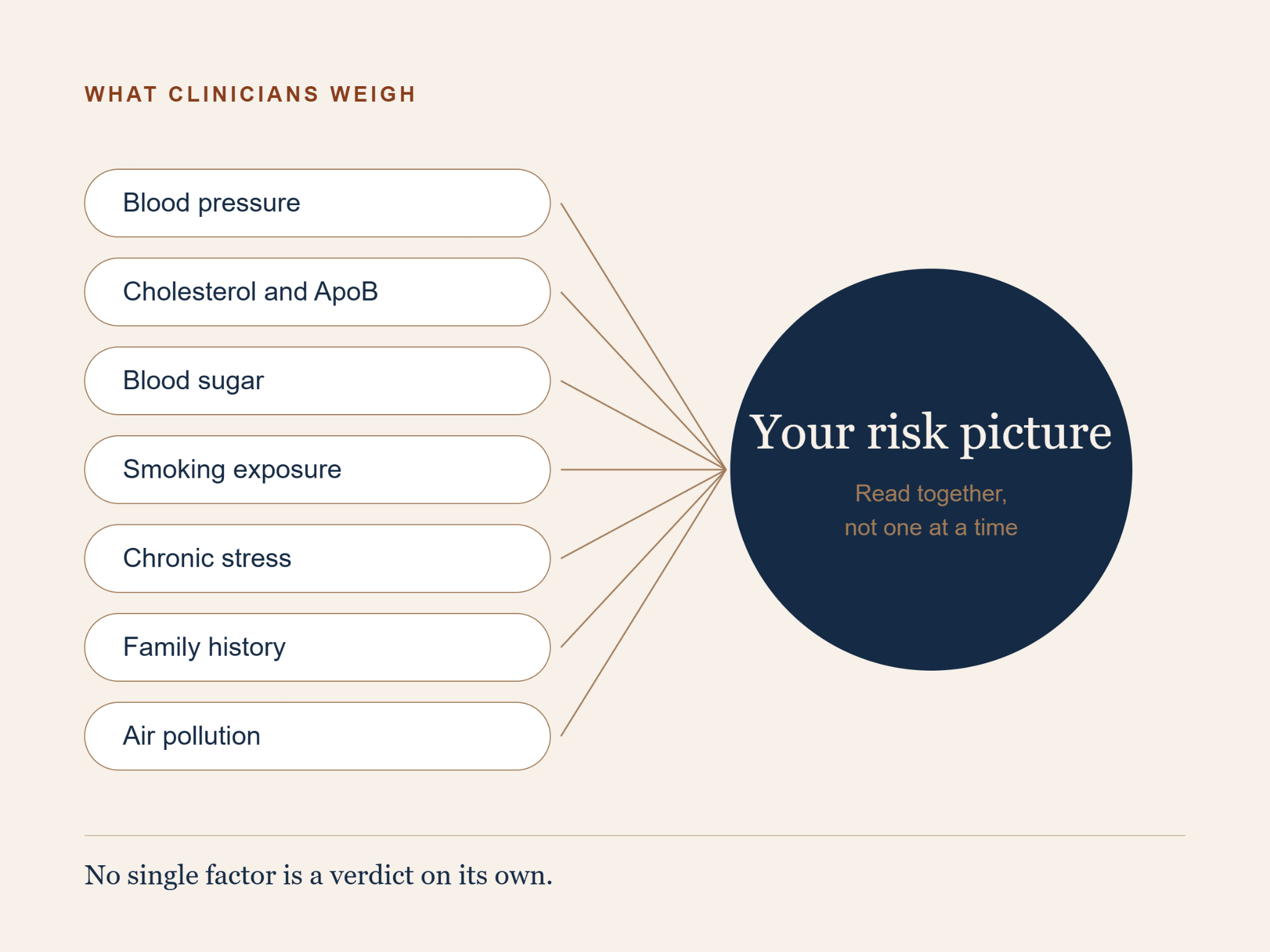
None is a verdict by itself. A person with normal cholesterol and a strong family history may need a different plan than someone with elevated ApoB and no family history. The work is putting the factors together. At PrimaryMD, we build that picture before your first visit, using your intake history and prior results, so the conversation starts from your actual risk rather than a generic checklist.
What can routine heart tests reveal before symptoms appear?
Which tests establish a useful baseline?
Most early detection happens with ordinary tests:
- Blood pressure measurement, which catches hypertension before it damages arteries.
- A cholesterol panel, with ApoB added when a more detailed assessment of atherogenic particles could affect care.
- Glucose and HbA1c, which catch diabetes and prediabetes early.
- An ECG, which records the heart’s electrical rhythm and can reveal abnormalities a patient never feels.
These are inexpensive, available in most doctors’ offices, and meaningful because they are repeated. A single reading is a snapshot. Tracked over time, the trend is the signal. As we explain in our approach to personalized diagnostic planning, the value is in the sequence, not the single number.
At PrimaryMD, our physicians use these results to decide whether a member needs monitoring, additional bloodwork, an exercise assessment, imaging, or specialist evaluation. The next test should answer a specific question about risk or symptoms.
When should you discuss an ECG or heart scan?
What can an ECG show?
An electrocardiogram records the heart’s electrical activity. It can provide information about heart rhythm and other patterns that may warrant further evaluation. It cannot answer every question about cardiovascular health, and a normal ECG does not rule out every form of heart disease.
In June 2026, NewYork-Presbyterian and Columbia announced FDA clearance for EchoNext, an artificial-intelligence tool that analyzes ECGs to identify people who may have a higher likelihood of structural heart disease. The NYP announcement describes a new way to use a routine test. This development does not mean every New Yorker needs an ECG or AI analysis. It does not replace physician evaluation or diagnostic work when symptoms or risk factors call for them.
What can an echocardiogram show?
An echocardiogram shows the heart’s chambers, valves, and muscle, including how well the heart pumps and how blood flows through it. A physician may consider one when symptoms, a heart murmur, an abnormal ECG, or another finding raises concern about the heart’s structure or function. It evaluates the heart itself, while a coronary artery calcium scan looks for calcified plaque in the arteries. When the concern is plaque in the coronary arteries rather than the heart’s structure, a different type of scan may be relevant.
What does a coronary artery calcium scan answer?
A coronary artery calcium scan uses computed tomography to look for calcium deposits in the walls of the coronary arteries. The result can help estimate the presence of calcified plaque and may support a discussion about cardiovascular risk management for selected patients.
Its value depends on age, family history, existing risk factors, prior results, radiation exposure, and the likelihood that the result will change management. A physician should explain those trade-offs before recommending the scan.
The reason for testing determines what happens next. At PrimaryMD, our physicians consider the patient’s symptoms, risk factors, examination findings, and prior results before recommending follow-up. When appropriate, we coordinate cardiology care.
When Should Changes in Exercise Performance Be Evaluated?
A new or persistent decline in pace, unusual fatigue, difficulty recovering, or shortness of breath may warrant discussion with a physician, particularly when the change is repeatable or occurs alongside other symptoms. Exercise testing can measure how the heart, circulation, breathing, blood pressure, and recovery respond as physical demand increases. It may be useful when someone has unexplained exercise intolerance or when a physician needs more information before creating a training plan. Exercise performance can provide useful context, including changes in heart-rate response, recovery, and tolerance for physical activity. Heather Milton, MS, a Registered Clinical Exercise Physiologist and Certified Strength and Conditioning Specialist, contributes expertise in interpreting these patterns.
Wearable data can help identify trends, although smartwatch estimates and laboratory measurements answer different questions. This guide to VO₂ max testing and wearable estimates explains why the numbers may differ. Exercise data does not diagnose heart disease on its own, so a physician should interpret it alongside symptoms, medical history, medications, examination findings, and other test results.
What questions should New Yorkers ask during a heart-health visit?
Bring questions that connect testing to decisions:
- Which cardiovascular risk factors are most important in my history?
- What do my blood pressure, cholesterol, and glucose results suggest when considered together?
- Would ApoB, lipoprotein(a), an ECG, a coronary calcium scan, or another test change my care?
- What symptoms or changes in exercise tolerance should prompt a call?
- Who will review the result with me, and what happens if it is borderline?
- When should I repeat the evaluation?
- If I need a cardiologist, who will coordinate the referral and follow-up?
These questions help keep clinical evaluation connected to decisions.
What should you do next?
Heart disease screening in NYC should begin with risk, symptoms, history, and daily life. Specialized tests can be valuable when they answer a specific question and may change care. They add less value when ordered without a plan for interpretation or follow-up.
At PrimaryMD, our physicians review cardiovascular risk over time, involve Heather Milton when exercise and performance data can clarify the picture, and coordinate specialist care when a finding requires additional evaluation. The next step is a conversation about your history, goals, symptoms, and current care, not a predetermined list of tests.Speak with the PrimaryMD care team to discuss whether the model fits your needs.
FAQs
Is heart disease screening in NYC different from screening elsewhere?
The underlying medical principles are the same, but New Yorkers can use city-specific resources such as the NYC Health Department’s heart-disease guidance, the HealthyNYC prevention strategy, and screening services through NYC Health + Hospitals. Your physician should still tailor evaluation to your individual risk.
Should everyone get a coronary calcium scan?
No. A coronary calcium scan may help selected patients, but age, risk factors, family history, prior results, radiation exposure, and the likelihood of changing treatment all matter. Discuss the potential value and limitations with your physician.
Does a normal ECG mean my heart is healthy?
A normal ECG can be reassuring in the right context, but it does not rule out every heart or vascular condition. Your physician may consider symptoms, examination findings, risk factors, and other tests when deciding whether additional evaluation is appropriate.
Can exercise testing diagnose heart disease?
Exercise testing can provide information about exercise capacity, heart-rate response, blood-pressure response, symptoms, and recovery. It does not provide a complete diagnosis by itself. A physician should determine whether testing is appropriate and how the results fit with the rest of your evaluation.
Does PrimaryMD membership replace health insurance or emergency care?
No. Membership does not replace health insurance, hospital care, or emergency treatment. Call 911 or seek emergency care for symptoms such as severe chest pain, serious breathing difficulty, fainting, or other potentially life-threatening symptoms.
What happens if PrimaryMD recommends a cardiologist?
Our care team can help coordinate the referral and make sure relevant information returns to the physician managing your broader plan. The receiving specialist remains responsible for specialty evaluation and treatment, while the PrimaryMD physician continues to manage the primary-care context.