

Rebuilding strength after 40 starts with a clear understanding of what you want exercise to accomplish. Your plan will look different if your priority is improving metabolic health, returning to tennis, preparing for a race, building muscle, managing an old injury, or staying capable and independent as you age.
Once the goal is clear, you can choose the right combination of strength training, aerobic fitness, mobility, and recovery. For busy New Yorkers, that may mean two focused sessions in an apartment gym, a structured program at a commercial gym, or workouts adapted around work, travel, and inconsistent schedules.
Key Takeaways
- Evaluate your goals, health history, current fitness, and schedule before building an exercise plan.
- Strength training should work alongside aerobic fitness, mobility, and recovery.
- A gradual progression helps adults return to exercise while reducing avoidable injury risk.
- Heather Milton and the PrimaryMD team can help connect clinical context with an exercise plan that fits your goals and capacity.
Evaluating your goals before starting
Start with your goal. Building strength, improving endurance, changing body composition, returning to a sport, and managing a health condition each require a different exercise plan. Your current fitness, medical history, schedule, and training experience should determine where you begin.
Before choosing exercises, consider:
- What do you want to improve?
- What activities do you enjoy or want to return to?
- How much time can you reliably dedicate each week?
- What injuries, medical conditions, or medications could affect training?
- How will you know that the plan is working?
At PrimaryMD, we can help patients establish that context before exercise becomes a list of disconnected workouts. The plan should reflect the person’s health, schedule, experience, and priorities.
I agree. That section states a basic premise without advancing the article. I would replace it with a more useful question:
Why do exercise plans fail for busy New Yorkers?
Many adults over 40 approach exercise in bursts: an ambitious weekend workout, a new class, or a demanding training plan followed by long gaps. Desk-based work, travel, long days, and inconsistent sleep can make that pattern difficult to sustain.
Common problems include:
- Increasing intensity before building consistency
- Training only one area, such as cardio without strength work
- Ignoring previous injuries or current limitations
- Leaving too little time for recovery
- Choosing a program that does not fit the week
A sustainable plan starts with a realistic schedule, a clear progression, and enough flexibility to adapt when work or travel disrupts the routine. The aim is to build a system you can repeat, then increase the challenge as your capacity improves.
This section adds a real insight, speaks directly to busy NYC professionals, and creates a natural transition into the four components of the plan.
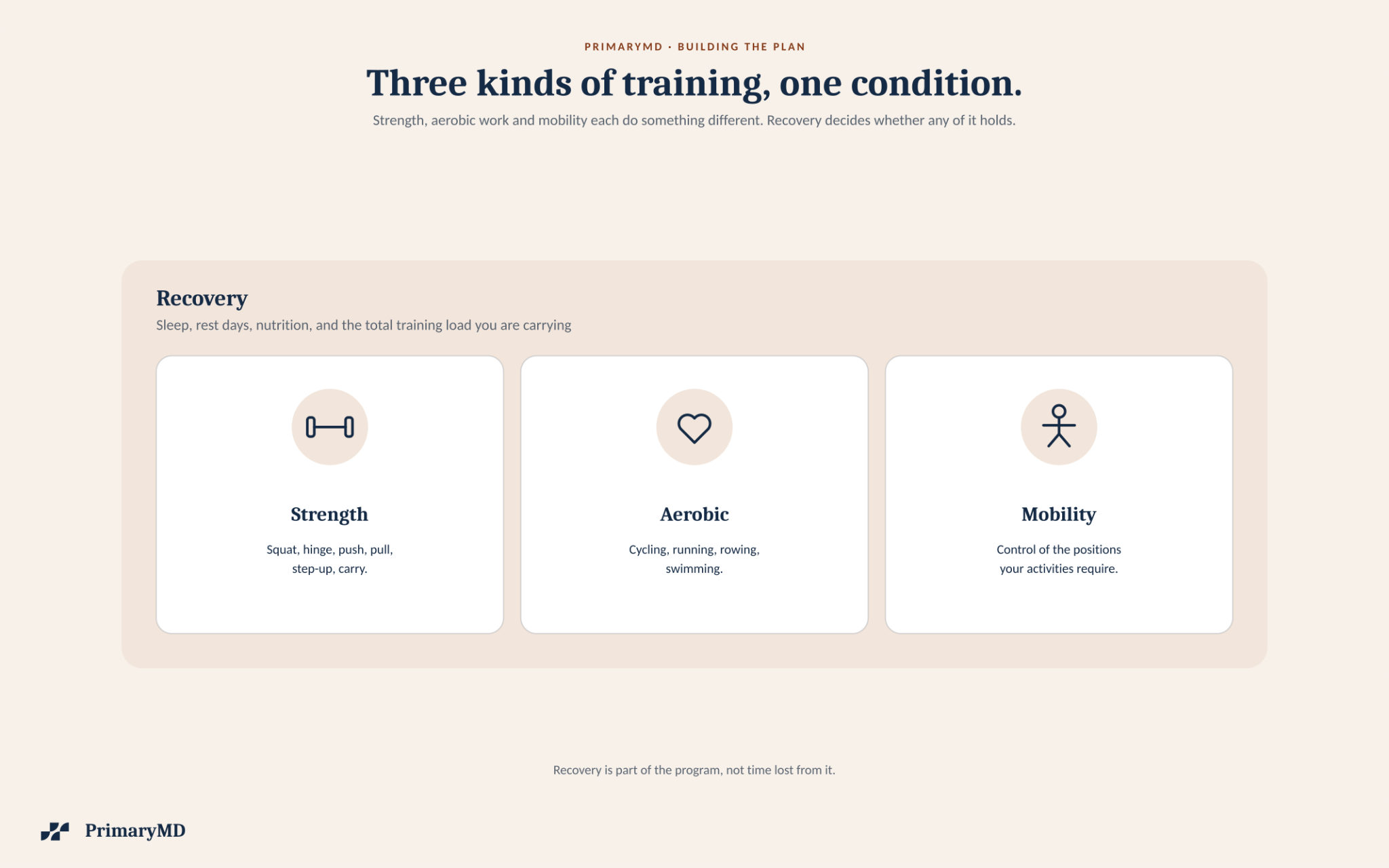
What should a sustainable exercise plan include?
How should you approach strength training?
Strength training uses resistance to challenge major muscle groups. That resistance may come from dumbbells, machines, resistance bands, bodyweight exercises, or other equipment.
A balanced session may include:
- A squat or sit-to-stand movement
- A hinge such as a deadlift pattern
- A pushing exercise
- A pulling exercise
- A step-up or split-stance movement
- A carry, plank, or other trunk exercise
The exercises should match your current ability and your goals. Someone focused on general strength may need a different exercise selection and progression from someone preparing to return to tennis or skiing.
How should aerobic fitness fit into the plan?
Aerobic training challenges the heart and lungs through activities such as cycling, running, swimming, rowing, or structured cardio equipment. It supports cardiovascular fitness and helps you tolerate more demanding activity.
The CDC recommends at least 150 minutes of moderate-intensity aerobic activity each week and muscle-strengthening activity on at least two days. Those guidelines provide a general framework. Your starting point may be lower if you are returning after a long break, recovering from an injury, or managing a medical condition.
Why do mobility and recovery matter?
Mobility work helps you control the positions your chosen activities require. Recovery includes sleep, rest days, nutrition, and managing the total amount of training stress.
A plan that repeatedly leaves you exhausted, unusually sore, or unable to complete normal activities may need adjustment. Recovery is part of the program rather than time lost from it.
How can you restart without getting injured?

Begin with movements you can perform with control. During the first few weeks, use a resistance that allows you to maintain stable technique and finish each set with room for additional repetitions.
Progress by changing one variable at a time:
- Add a small amount of weight
- Increase repetitions
- Add a set
- Extend an aerobic session
- Increase training frequency
Avoid increasing every variable during the same week. A gradual progression makes it easier to identify what your body can tolerate and gives you a clearer way to adjust the plan.
Heather Milton, MS, PrimaryMD’s Lead Exercise Physiologist, brings experience in clinical exercise physiology, strength and conditioning, metabolic assessment, and performance testing. Her work focuses on identifying an appropriate starting point, then building strength, aerobic capacity, and training tolerance through a progression that fits the individual.
How should you choose weights, repetitions, and intensity?
The right weight depends on the exercise, your experience, technique, and goal. Choose a resistance that allows you to finish each set with a few controlled repetitions left and consistent form.
For aerobic training, the talk test can help estimate moderate intensity: you should be able to speak in short sentences while breathing more heavily. Heart-rate data adds context, although medications, stress, sleep, illness, and temperature can affect the number.
What could a realistic weekly plan look like?
Your schedule should influence the structure of the week.
A busy professional may need a plan that works in a 35-minute apartment-gym session. Someone who travels frequently may need hotel-room strength options and a clear way to resume training after a disrupted week. Someone preparing for a sport may need more specific aerobic and movement progressions.
The most useful schedule is the one you can repeat and adapt.
When should pain, fatigue, or poor recovery be evaluated?
Some muscle soreness is common after an unfamiliar workout. Sharp pain, joint swelling, instability, or pain that changes how you move deserves attention.
You should also discuss exercise with a physician when you experience:
- Chest pressure or discomfort
- Fainting or near-fainting
- Unusual shortness of breath
- Palpitations during activity
- A sudden decline in exercise tolerance
- Fatigue that persists beyond expected recovery
- Repeated symptoms during ordinary exertion
- A strong family history of early heart disease
PrimaryMD physicians consider symptoms, blood pressure, cholesterol, glucose, medications, family history, prior results, and current activity before determining whether additional evaluation is appropriate. Depending on the situation, that may involve monitoring, laboratory testing, an ECG, exercise testing, or referral to a specialist.
How can testing help personalize an exercise plan?
Testing can be useful when it answers a specific question. VO₂ max testing may help assess aerobic capacity. Metabolic testing can provide information about how the body uses energy during exercise. Movement or strength testing may identify asymmetries, limitations, or areas for targeted training.
Wearables can show trends in heart rate, sleep, training load, and recovery. Their estimates can be useful, but they require context. PrimaryMD’s guide to VO₂ max testing and wearable data explains why consumer estimates and laboratory measurements may differ.
What should New Yorkers remember about rebuilding strength after 40?
A productive exercise plan begins with your goals. It then accounts for your health, experience, schedule, available equipment, and ability to recover.
Strength training, aerobic fitness, mobility, and recovery each contribute something different. Start at a level you can control, progress gradually, and evaluate symptoms that fall outside expected training discomfort.
PrimaryMD can help patients establish the medical context for exercise, while Heather’s exercise physiology expertise can help translate that context into a practical plan.
Frequently asked questions
Can I build strength after 40 if I have been inactive for years?
Yes. Begin with manageable movements, appropriate resistance, and a gradual progression. Your starting point should reflect your current strength, mobility, health history, and recovery capacity.
Do I need a medical evaluation before starting strength training?
Many adults can begin with light or moderate activity, but people with cardiovascular risk factors, chronic conditions, significant inactivity, or concerning symptoms may benefit from speaking with a physician before increasing intensity.
How often should I strength train after 40?
Many adults can begin with two full-body sessions each week. The appropriate frequency depends on your goals, training history, recovery, and other activities.
How quickly should I increase the amount of weight I lift?
Increase resistance when you can complete the current exercise with stable technique and controlled effort. Small changes are easier to evaluate and may reduce injury risk.
Does PrimaryMD membership replace health insurance or emergency care?
No. Membership does not replace health insurance, hospital care, or emergency treatment. Chest pain, fainting, severe shortness of breath, or other urgent symptoms require immediate medical attention.