

Key Takeaways
- When you see multiple specialists in NYC, care coordination often falls to the patient unless a primary care physician is clearly responsible for the whole plan.
- Fragmented care can leave patients chasing records, repeating their history, comparing recommendations, and deciding which abnormal result or referral matters most.
- Proper coordination means one physician reviews specialist input, reconciles conflicts, tracks open items, updates the medication list, and explains what should happen next.
- At PrimaryMD, we review outside notes and results, coordinate specialist recommendations, and keep each member's care plan moving after the visit ends.
How does specialist care usually play out in NYC?
Here is a common pattern in New York: a patient has a cardiologist at one institution, a dermatologist in private practice, and lab work from an executive physical. Each physician may be excellent. Then the patient is left to connect the pieces. They forward records. They explain the same history again. They chase lab results. They ask one specialist whether another specialist's recommendation matters. They try to remember which medication changed, which scan needs follow-up, and which abnormal result was supposed to be repeated.
When you see multiple specialists in NYC, your primary care physician should coordinate the whole plan and help decide what deserves attention now, later, or not at all.
Why does this happen so often in New York?
New York gives patients deep specialist access, but the care often gets scattered across systems. Each specialist may see one part of the patient; the gap appears when no physician is responsible for combining those findings into one plan. At PrimaryMD, one physician keeps the broader record, risk profile, and open issues in view.
What does fragmented specialist care do to the patient?
The patient becomes a project manager. That can create confusion, delay, duplicated work, and unnecessary worry.
Small gaps can become real friction:
- A medication change from one specialist affects a condition managed by another.
- Two specialists recommend different follow-up timelines.
- A scan finds an incidental issue, but no one explains how urgent it is.
- The patient becomes the messenger between offices.
- A referral is placed, but no one confirms whether the visit happened.
The clinical risk is often a weak decision process. Patients may overreact to minor findings, underreact to important ones, repeat tests unnecessarily, or delay a simple next step because no one has put the record in order.
For patients with demanding schedules, frequent travel, or care split across multiple cities, those gaps become easier to miss.
What should coordinated care actually look like?
Coordinated care should turn specialist input into decisions. After a specialist visit, the primary care physician should understand the recommendation and decide how it fits with the patient's history, medications, risks, and other care.
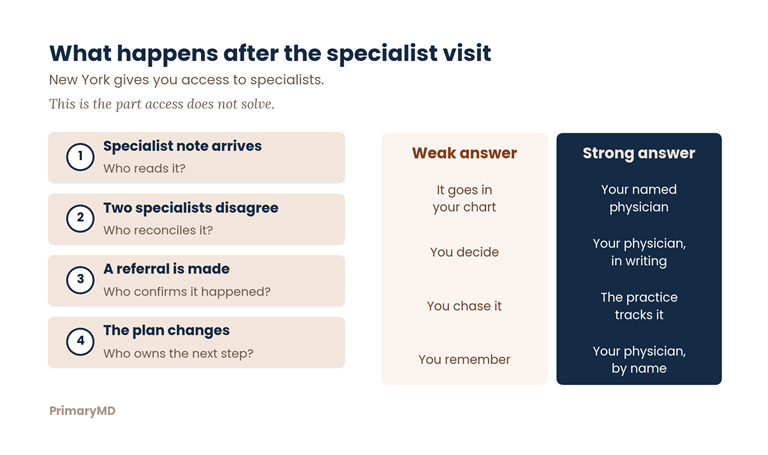
Useful coordination usually includes several steps:
- Confirm what the specialist recommended.
- Identify any medication, testing, or follow-up changes.
- Check whether the recommendation conflicts with other advice.
- Explain what the patient should do now, later, or not at all.
- Track whether the next step actually happens.
- Update the long-term care plan.
The patient should leave with fewer loose ends.
Our physicians review outside notes in context. When a recommendation changes the plan, we explain why. When it does not change care, we say that too.
What should happen when two specialists disagree?
Specialists can disagree for good reasons: different risks, guidelines, or clinical priorities. A coordinating physician should compare the recommendations, clarify the trade-off, and help decide which path fits the patient’s full history. Sometimes that means calling the specialist, ordering a targeted follow-up test, or explaining that one recommendation can wait. At PrimaryMD, we also use restraint: tests, scans, prescriptions, and referrals should have a reasonable chance of changing care.
Who keeps track of abnormal results and open referrals?
Your primary care physician should keep track, with support from the care team. Abnormal results need interpretation, prioritization, and a clear next step. Open referrals need the same ownership: someone should know whether the visit happened, whether the recommendation came back, and whether it changes the plan.
At PrimaryMD, the physician remains responsible for clinical decisions, while the care team helps track results, referrals, records, and follow-up items against one evolving plan.
When does concierge primary care help with specialist coordination?
A concierge primary care model may make sense when care has too many moving parts for standard visits to hold: frequent travel, multiple specialists, chronic conditions, complex prevention goals, or care split across cities. It may be less useful for someone with simple needs and a strong primary care relationship already coordinating care well.
Concierge care also has limits. It does not replace insurance, hospital care, emergency treatment, specialist fees, prescriptions, procedures, or outside services. Urgent symptoms may still require urgent care or the ER, and a responsible physician may decline requests for scans, prescriptions, or referrals that are unlikely to improve care.
How does PrimaryMD coordinate specialist care in NYC?
For New York members, we begin by mapping the current care picture: active specialists, prior diagnoses, medications, labs, imaging, family history, symptoms, travel patterns, and prevention priorities. Our NYC physician team includes Dr. Michael Billington, a dual board-certified physician in Emergency Medicine and Critical Care who serves on faculty at Harvard Medical School.
When a specialist becomes involved, we help keep the loop closed. That can include preparing the clinical question before the referral, reviewing the note afterward, and helping the patient understand what deserves action.
During regular hours, our team handles ongoing and same-day care across New York City. After hours, 24/7 urgent care is included through our partner Sollis Health at member-only centers and by telemedicine.
What should one clear medical plan actually give you?
A clear medical plan should show what is active, what is stable, what needs follow-up, and who owns each next step. For New York patients with multiple specialists, the right primary care relationship keeps the whole picture visible after each specialist has spoken.
PrimaryMD content is educational and does not replace individualized medical advice or emergency care. Services, availability, pricing, and membership terms should be confirmed directly with our team.
Frequently Asked Questions
Can my specialist coordinate all of my care?
A specialist can coordinate care within their field. A cardiologist may manage cardiovascular risk, while a gastroenterologist manages colonoscopy timing or digestive symptoms. A primary care physician is usually better positioned to reconcile those recommendations across conditions, medications, prevention goals, and everyday care.
What if I already have excellent specialists in NYC?
Excellent specialists are valuable. Coordination becomes important when each specialist is working from a partial view. A strong primary care physician can preserve those relationships while making sure the recommendations connect to one plan.
Should I switch specialists when I join a concierge practice?
Not necessarily. Many patients keep existing specialists. The more important question is whether your primary care physician can review outside notes, communicate with specialists when needed, and help you decide which recommendations should change your plan.
Does specialist coordination mean PrimaryMD controls what my specialists do?
No. Specialists remain responsible for their own recommendations and procedures. We help interpret those recommendations in the context of your broader health, identify conflicts, and keep follow-up moving. When something requires emergency care, hospital care, or specialist management, we direct patients to the appropriate setting.
Is concierge care worth it if my main problem is fragmented care?
It may be worth considering if fragmented care is causing delayed follow-up, repeated explanations, conflicting recommendations, unclear medication changes, or unresolved abnormal results. Whether it helps depends on whether the practice has enough physician time and process to coordinate the work.