
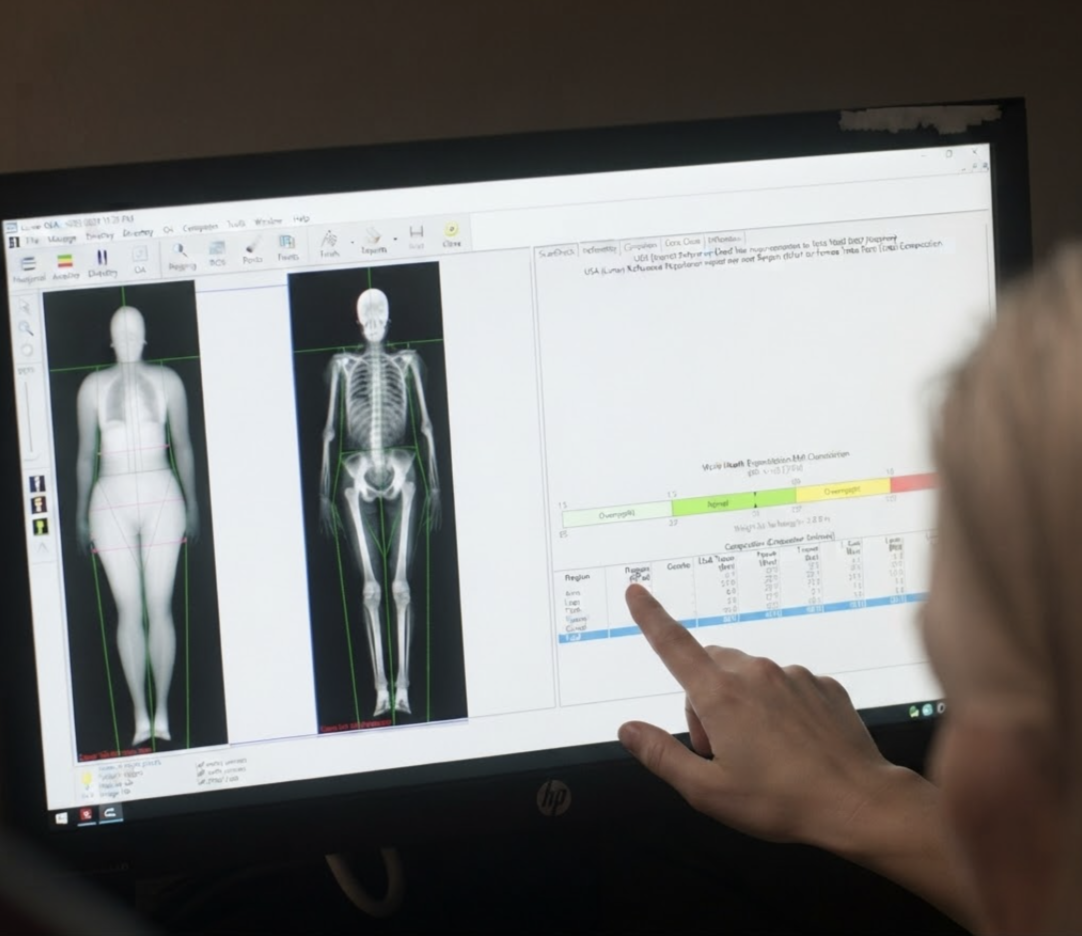
A DEXA scan is comprehensive but it does not automatically tell you what to change. The scan can separate your weight into fat mass, lean mass, visceral fat, and bone density, which makes it useful for people trying to lose weight, build strength, understand metabolic risk, or establish a baseline for long-term health. The harder part is deciding which numbers matter, which ones are noise, and what should happen next.
The simplest way to read a DEXA report is to focus on four questions. How much fat are you carrying? Where is that fat stored? How much lean mass do you have? Are your bones protected? Body fat percentage, visceral fat, lean mass, and bone density each answer a different part of the picture. The scan should not be read as a scorecard. It should be read as a way to decide what deserves action, what deserves monitoring, and what can safely be ignored.
What a DEXA Scan Actually Tells You
DEXA stands for dual-energy X-ray absorptiometry. It has long been used to measure bone mineral density, but it is also widely used for body composition because it can estimate how much of your body mass comes from fat, lean tissue, and bone. A typical body composition report may show total body fat percentage, fat mass, lean mass, regional fat distribution, and an estimate of visceral adipose tissue, which is the deeper abdominal fat stored around internal organs.
That breakdown matters because the same weight can reflect very different physiology. One person may have a normal BMI but low lean mass and elevated visceral fat. Another may weigh more because they carry more muscle and less abdominal fat. The report is useful when it helps explain which of those patterns is present.
Bone density belongs in a separate category from body composition. A body fat result may point toward changes in nutrition, training, or metabolic testing, while a low bone density result may require a medical review of fracture risk, menopause status, medications, vitamin D, calcium intake, hormone factors, prior fractures, and family history. A DEXA scan can include both types of information, but they should not be interpreted in the same way.
For readers still comparing DEXA basics, PrimaryMD’s guide to DEXA scan cost and DEXA body fat results can help explain the difference between pricing, body composition metrics, and what the report usually includes.
The Four Parts of the Report to Read First
Body fat percentage is the number most people notice first. It can help show whether your current weight reflects excess fat, a healthy amount of lean mass, or a mismatch between the two. It is also useful when the scale is not moving much but your training or nutrition plan may still be changing your body composition.
Visceral fat, the deeper abdominal fat stored around internal organs, is more closely tied to cardiometabolic risk than subcutaneous fat, which sits under the skin. If visceral fat is elevated, the next step is usually to review the broader metabolic picture: blood sugar, insulin, lipids, blood pressure, liver markers, sleep, alcohol intake, and family history. The result does not diagnose insulin resistance by itself, but it may tell you where to look next.
Lean mass is one of the most important numbers for people in their 40s, 50s, and 60s. Muscle supports strength, glucose control, injury prevention, mobility, and long-term function. Low or falling lean mass may suggest under-fueling, insufficient resistance training, poor recovery, or a medical factor worth reviewing. This is especially relevant if you are losing weight quickly, using a GLP-1 medication, recovering from injury, or noticing a decline in strength.
Bone density should be read differently from body composition. Low bone density may reflect menopause, low body weight, vitamin D deficiency, certain medications, endocrine issues, prior fractures, family history, or insufficient resistance training. The goal is not just to improve the score; it is to understand fracture risk and why bone density is low.
To sum up: Each part of the report answers a different clinical question. Body fat shows composition, visceral fat points toward metabolic risk, lean mass reflects strength and function, and bone density helps assess fracture risk.
Where DEXA Results Often Mislead People
Body fat percentage is easy to overvalue because it looks like the headline number. But a DEXA scan is more useful when body fat is read against lean mass and visceral fat. A higher body fat percentage with strong lean mass and low visceral fat may call for a gradual fat-loss plan. Normal body weight with low muscle and elevated visceral fat may call for a very different approach: strength training, metabolic labs, and a closer look at insulin resistance risk. The point is to understand what kind of body composition you actually have.
Scale weight can fall for reasons that do not all mean progress. A person may lose fat, lean mass, water, or some combination of the three. DEXA can help clarify whether a weight-loss plan is improving body composition or simply making the number on the scale smaller. Losing weight is not the same thing as protecting future health if the process also weakens muscle, lowers performance, or leaves metabolic risk unchanged.
Small changes between scans can be misleading. DEXA is useful, but minor shifts may reflect hydration, positioning, machine differences, recent training, food intake, or normal measurement variation. A small change should not automatically lead to a major change in plan. The more useful signal is whether the pattern is consistent, meaningful, and aligned with what is happening in your labs, symptoms, training, and daily life.
A single scan rarely tells the whole story. The first DEXA is usually most useful as a starting point, especially if you are changing your nutrition, training, medication, sleep, or weight. The trend matters because it shows direction: whether visceral fat is falling, lean mass is being preserved, bone density is stable, or the plan needs to be reconsidered.
What to Do Based on Your Main Result Pattern
If your scan shows high body fat but your lean mass is reasonable, the next step is usually to focus on fat loss without sacrificing muscle. That often means a sustainable nutrition plan, progressive resistance training, enough protein, sleep improvement, and metabolic labs if visceral fat or family history raises concern. The goal is to reduce fat while preserving the muscle and function you want to keep.
If your scan shows elevated visceral fat, the result should be treated as a metabolic signal rather than a cosmetic one. This is where DEXA can connect to a broader review of prediabetes risk, cholesterol patterns, liver health, blood pressure, sleep apnea risk, alcohol use, and family history. A person can look outwardly healthy and still carry risk that a standard scale or BMI calculation misses.
If your scan shows low lean mass, the plan should usually shift toward preserving or building muscle. That may involve resistance training, protein targets, physical therapy if injury is limiting movement, recovery review, medication review, and sometimes further lab evaluation if the result does not match your effort. Low lean mass matters because the goal of longevity is not just living longer; it is preserving the strength and function that make longer life better.
If your scan shows low bone density, the next step is more medical than aesthetic. Bone density should be reviewed through fracture history, menopause status, medications, vitamin D, calcium intake, alcohol use, smoking, family history, and whether formal osteoporosis evaluation is needed. Current screening guidance supports bone density screening for women 65 and older, and for postmenopausal women under 65 when risk factors suggest elevated fracture risk. For men, formal screening guidance is less settled, but low bone density or fracture history should still be taken seriously.
Why DEXA Matters During Weight Loss or GLP-1 Use
DEXA can be especially useful if you are losing weight quickly or taking a GLP-1 medication such as semaglutide or tirzepatide. Recent research on GLP-1 and dual GLP-1/GIP therapies shows reductions in body weight, BMI, waist circumference, fat mass, and visceral adipose tissue. Lean mass still deserves attention during any major weight-loss intervention, but the answer is not panic. The answer is to track what is changing and adjust the plan as needed.
During GLP-1 treatment, DEXA can turn a vague concern about “muscle loss” into something measurable. If lean mass is falling faster than expected, the plan may need more resistance training, more protein, slower weight-loss pacing, or closer monitoring of strength and function. If fat mass and visceral fat are improving while lean mass is relatively preserved, the current strategy may be working.
Why the Trend Matters More Than the Snapshot
DEXA becomes more useful when it shows change over time. In bone health, researchers have started using repeated scans to model osteoporosis trajectory and potential recovery during treatment, though these models are still early and should not replace clinical judgment. The same principle applies to body composition: if visceral fat is falling, lean mass is stable, and bone density is protected, that suggests progress a scale may not capture. If weight is falling while muscle or bone markers are moving in the wrong direction, the plan may need to change.
When to Review DEXA Results With a Physician
You should consider reviewing your DEXA results with a physician if your bone density is low, your visceral fat is elevated, your lean mass is low or falling, you are losing weight quickly, you are using a GLP-1, or your results do not match your BMI, labs, or how you feel. You should also seek clinical interpretation if you have a family history of osteoporosis, diabetes, early heart disease, frailty, or fractures.
A physician can help decide whether the scan is mainly a fitness baseline, a metabolic signal, a bone health issue, or a reason to look more closely at medications, hormones, nutrition, or training. Some findings call for action. The important part is knowing the difference, not just monitoring.
How PrimaryMD Uses DEXA in Proactive Care
At PrimaryMD, DEXA is reviewed as part of a broader baseline that may include advanced biomarkers, cardiometabolic risk assessment, VO2 max, CGM data when appropriate, medications, symptoms, family history, wearable trends, and personal goals. That broader view helps the physician decide what should change, what should be watched, and what should be revisited later.
A DEXA result should not sit in a portal waiting for the patient to interpret it alone. It should be connected to a plan, tracked over time, and adjusted as the patient changes. That is also why DEXA fits naturally into PrimaryMD’s broader approach to smarter, technology-enabled proactive care, where diagnostics, wearables, labs, and follow-up are reviewed by one physician-led team.
Frequently Asked Questions
What should I look at first on a DEXA scan?
Start with the result most likely to change your plan. For some people, that is body fat or visceral fat. For others, it is low lean mass, unexpected bone loss, or a mismatch between BMI and body composition. The best first step is to identify the main pattern rather than reacting to every number on the report.
What does visceral fat mean on a DEXA scan?
Visceral fat is deeper abdominal fat stored around internal organs. Elevated visceral fat may be associated with cardiometabolic risk, including insulin resistance, fatty liver risk, abnormal lipids, and high blood pressure. It should be reviewed with labs, blood pressure, family history, sleep, nutrition, exercise, and alcohol intake.
Can a DEXA scan show if I am losing muscle?
DEXA can estimate changes in lean mass, which includes muscle and other non-fat tissues. It is useful during weight loss because it can show whether weight loss is mostly fat or whether lean tissue is also falling. Lean mass changes should be reviewed alongside strength, function, protein intake, resistance training, recovery, and overall health.
How often should I repeat a DEXA scan?
For body composition tracking, many people repeat DEXA after several months of meaningful change in training, nutrition, medication, or weight. Scanning too often can make small changes look more important than they are. For bone density, repeat timing depends on baseline results, fracture risk, and physician guidance.
Is DEXA useful if I am taking a GLP-1?
Yes. DEXA can be useful during GLP-1 therapy because it helps distinguish fat loss from lean mass loss. The goal is not only to lose weight, but to preserve muscle, reduce visceral fat, and maintain function. DEXA results can help guide protein intake, resistance training, and follow-up planning.
What does low bone density on a DEXA scan mean?
Low bone density may suggest osteopenia or osteoporosis depending on the score, age, sex, and clinical context. It should be reviewed alongside fracture history, menopause status, medications, vitamin D, calcium intake, family history, endocrine factors, and strength training. Low bone density is a medical finding, not just a body composition metric.
Do I need a doctor to interpret my DEXA scan?
You may be able to understand the basic categories yourself, but a physician can help decide whether the results should change your care plan. This is especially important if you have low bone density, high visceral fat, low lean mass, rapid weight loss, GLP-1 use, abnormal labs, or a family history of metabolic, cardiovascular, or bone disease.