

Key Takeaways
- Bi-coastal patients should manage health with one physician of record, one current medication list, one results-routing process, and one follow-up system across both states.
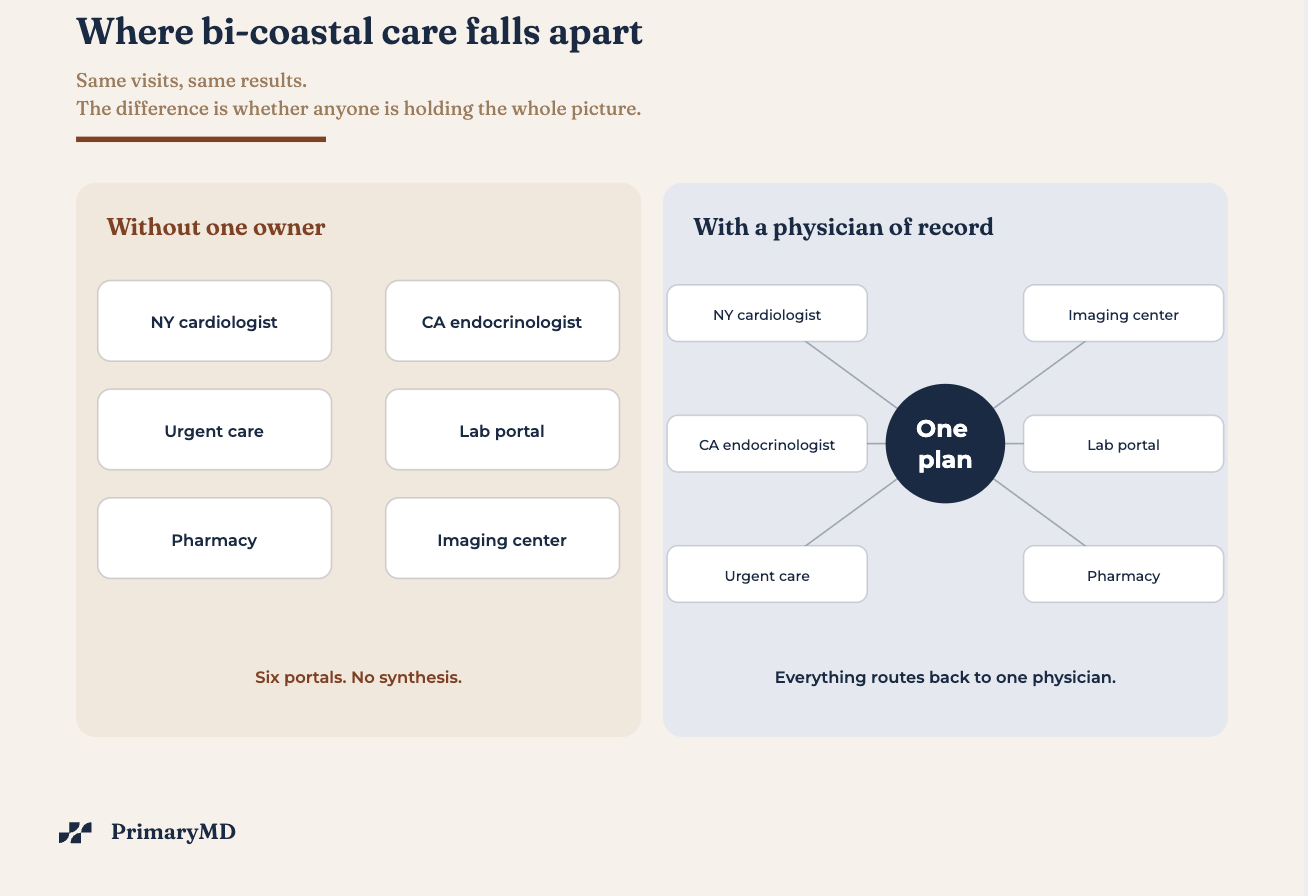
- The biggest risk is usually fragmentation. Lab results, specialist notes, urgent care visits, prescriptions, and imaging can scatter across portals unless someone owns the full plan.
- Frequent travelers should prepare before each trip by organizing medications, insurance details, urgent care options, recent records, and a clear process for sending outside results back to their physician.
- At PrimaryMD, we help members keep care coherent across New York and California by connecting results, medications, specialist input, and follow-up to one physician-led primary care plan.
How should bi-coastal patients manage health between New York and California?
Bi-coastal patients should manage health between New York and California by building a simple care system that travels with them. The system should define who owns the medical record, where outside results go, how medications are tracked, what to do when symptoms appear, and how specialist recommendations return to one care plan.
Most bi-coastal patients already have access to care. They can find specialists, schedule labs, use urgent care, and message clinicians in multiple cities.
The harder work is synthesis. A cardiology note in New York, a prescription change in California, and a lab result from a travel week only become useful when one physician sees the full pattern and decides what should happen next.
What should your bi-coastal health system include?
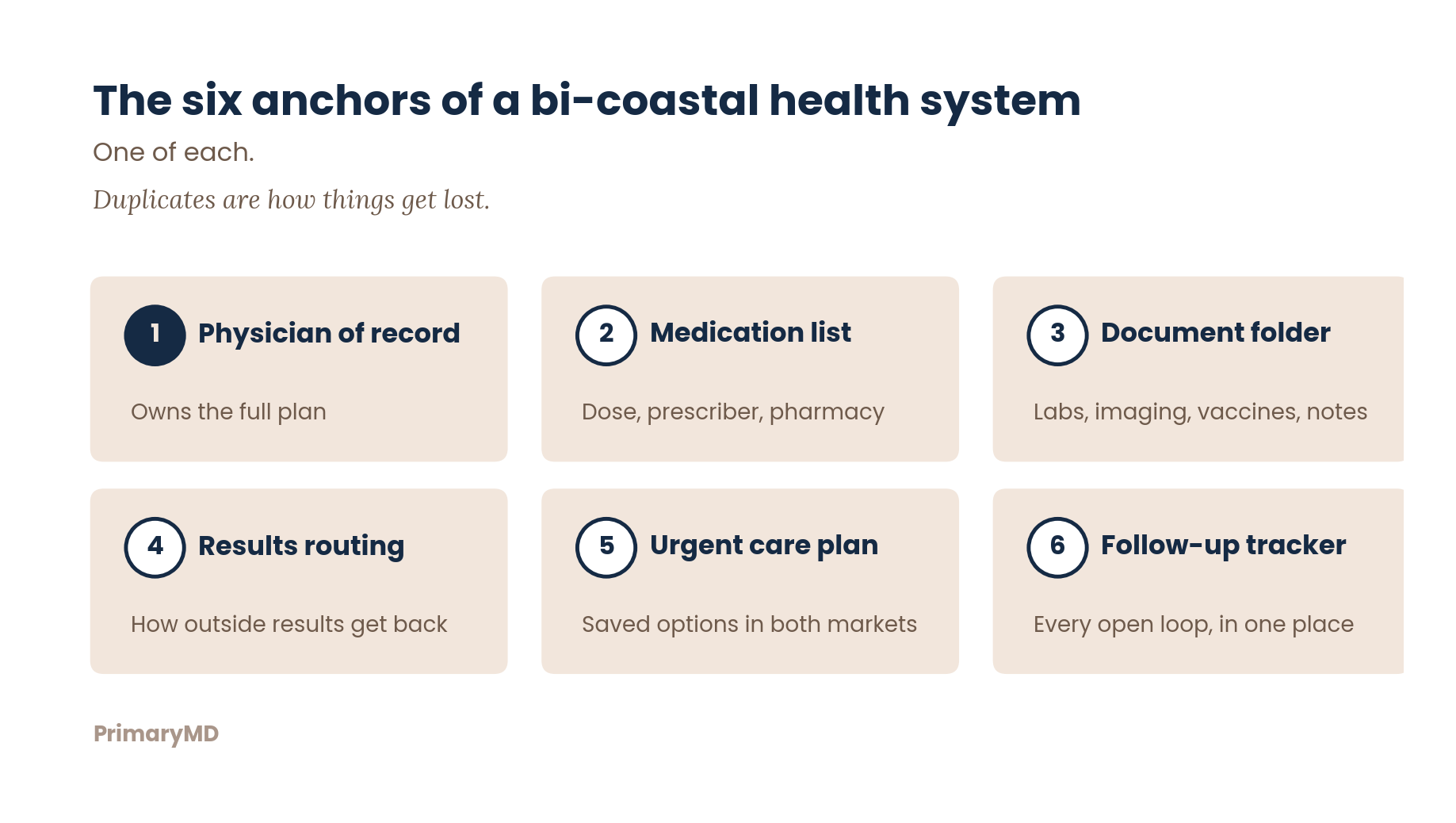
A bi-coastal health system should include one physician of record, one medication list, one document folder, one results-routing process, one urgent care plan, and one follow-up tracker. These pieces keep care from scattering every time you move between cities.
- Physician of record - Choose one primary physician who owns the full plan.
- Medication list - Keep one current list with dose, reason, prescribing doctor, and pharmacy.
- Medical documents - Store labs, imaging, vaccines, allergies, specialist notes, and procedures in one place.
- Results routing - Know how outside labs, urgent care visits, and specialist notes get sent back.
- Urgent care plan - Save preferred urgent care and emergency options in both markets.
- Follow-up tracker - Track open loops: pending results, referrals, repeat tests, and medication changes.
At PrimaryMD, we use the physician relationship as the anchor. When members share outside records, specialist notes, or results, our physicians can interpret them in context and bring them back into the ongoing care plan.
What should you do before each trip?
Before each trip, review medications, insurance access, pending results, and urgent care options.
This matters because travel problems tend to arrive at inconvenient moments: a delayed refill, a portal result that lands during meetings, a new symptom away from home, or a specialist note that never reaches the right physician.
Use this pre-travel checklist:
- Pack regular medications in your carry-on, with several extra days in case of delays.
- Keep a current medication list saved offline on your phone.
- Save digital insurance cards and concierge practice contact details offline.
- Confirm how your insurance works in the state you are visiting.
- Ask whether any pending lab, imaging, or specialist result is expected while you are away.
- Know how to send outside results back to your physician.
- Save preferred urgent care and emergency locations near where you stay.
- Pack a small health kit with basics such as bandages, pain reliever, thermometer, hand sanitizer, sunscreen, and any personal medical supplies you use.
For patients moving between New York and California, this preparation reduces the chance that a routine issue becomes a coordination problem.
How should you handle lab results while traveling?
Lab results that arrive while traveling should go back to the physician who owns your full care plan.
Before getting labs outside your usual practice, ask where the results will be sent. If the lab, specialist, or urgent care center cannot route results directly, download the PDF or screenshot the result and send it through the process your physician uses.
A PrimaryMD physician reviewing a shared result will check it against prior values, current risk, medications, symptoms, and the reason the test was ordered. That context helps prevent both overreaction to borderline findings and delays when a result needs attention.
Then ask a practical question: does this result require action now, repeat testing, monitoring, or no immediate change?
How should you manage prescriptions across coasts?
Bi-coastal patients should keep one medication list that follows them across both states. The list should include each medication name, dose, prescribing clinician, reason for use, pharmacy, start date, refill timing, and any side effects or monitoring needs.
Travel makes prescription management harder. A medication may run out while you are away, a local clinician may add something after urgent care, or a specialist may change a dose without the full list in front of them.
Before longer trips, ask your physician or pharmacy whether you can receive a travel supply or vacation override when appropriate.
At PrimaryMD, we review medication changes when members share them with us, then connect those changes back to the broader plan. Some prescriptions still require local evaluation, and controlled substances follow stricter federal and state rules. Patients who travel often should clarify medication limits before they leave.
What daily routines should travel patients keep consistent?
Frequent travelers should keep a few routines stable. Perfecting every health variable on the road is a losing game, and the most useful anchors are sleep timing, morning light, movement, hydration, protein intake, medication timing, and a predictable wind-down routine.
For sleep, try to shift toward local time quickly. Morning outdoor light at the destination can help the body clock adjust, especially after cross-country travel. Keep hotel sleep tools simple: earplugs, eye mask, a consistent alarm, and a room temperature that supports sleep.
For movement, plan for a minimum viable workout. Walking through airports, taking calls while walking, using hotel gyms, or doing 20 minutes of bodyweight exercise can preserve consistency during heavy travel weeks.
For nutrition, aim for a protein source and fiber-rich food at most meals, then accept that some meals will be imperfect.
These routines matter because bi-coastal health is shaped by repeated weeks. One trip barely registers.
The best travel routine is the one you can repeat.
What should you do when symptoms come up away from home?
When symptoms appear away from home, decide whether the situation needs emergency care, urgent local evaluation, physician triage, or monitoring.
Severe chest pain, stroke symptoms, severe shortness of breath, fainting, major injury, severe abdominal pain, or rapidly worsening symptoms should go to emergency care.
For urgent but stable issues, local urgent care may be the right first step. For unclear symptoms, your primary physician can often help decide whether to monitor, schedule a visit, use urgent care, or seek emergency evaluation. After any local visit, send the visit summary, prescriptions, labs, and imaging reports back to your physician of record.
PrimaryMD helps members keep these episodes connected. If a member receives local care while traveling, our physicians can review shared documentation, update the medication list or follow-up plan, and make sure the episode does not disappear into a separate portal.
How should specialists in two cities be coordinated?
Specialists in two cities should feed recommendations back into one primary care plan. A cardiologist in New York, an endocrinologist in California, and an orthopedist near home may each give reasonable guidance, and the patient still needs one physician to reconcile priorities, medications, repeat testing, and follow-up timing.
Before each specialist visit, ask the office to send the note and results to your physician of record. After the visit, confirm what changed: new diagnosis, new medication, repeat test, referral, procedure, or monitoring plan.
The primary physician should then decide how the recommendation fits with the rest of your care.
At PrimaryMD, we help members synthesize specialist input when records are shared with us. This is especially useful for patients who split time between New York neighborhoods such as Chelsea, Sutton Place, or the Upper East Side, and California locations such as Menlo Park, Noe Valley, or Palo Alto.
How should insurance be handled across New York and California?
Bi-coastal patients should confirm how their insurance works in both states before they need care. A plan with strong access in New York may have different network rules, referral requirements, or out-of-network costs in California. The same issue can happen in reverse.
Save your insurance card offline, confirm emergency coverage, check specialist network rules in both markets, and understand whether urgent care, imaging, labs, and hospital care will be in network. If you travel internationally as well, review travel health insurance and medical evacuation coverage before longer trips.
Concierge primary care covers the physician relationship and the services in the membership agreement. Patients still need health insurance for emergency care, hospitalizations, specialist fees, imaging, prescriptions, procedures, and outside testing.
How does PrimaryMD help bi-coastal patients?
PrimaryMD helps bi-coastal patients by keeping care connected to one physician-led plan. Our physicians can review shared records, interpret new results against prior values, coordinate specialist input, and document follow-up steps so the patient is not managing every open loop alone.
For members across New York and California, the practical work includes keeping the clinical history coherent, reviewing medication changes, clarifying what needs local care, and bringing outside episodes back into the plan.
If a member's life shifts from one primary location to another, our team handles the transition between PrimaryMD physicians so the record, care plan, medications, and open follow-up items move with them. Our membership page sets out what is included.
Who benefits most from bi-coastal concierge primary care?
Bi-coastal concierge primary care is most useful for patients with real coordination needs. This includes people who split time between New York and California, frequent business travelers, patients with multiple specialists, adults managing cardiovascular or metabolic risk, people with complex medication lists, and families whose care spans more than one market.
How should bi-coastal patients decide?
Bi-coastal patients should choose a care system that stays organized when life moves between cities. The system should define who owns the medical record, who reviews outside results, who maintains the medication list, who reconciles specialist advice, what happens during urgent episodes, and which follow-up tasks remain open.
If you want to see how those questions get answered here, speak with our care team.
Frequently Asked Questions
What is bi-coastal concierge primary care?
Bi-coastal concierge primary care is a physician-led primary care relationship for patients who split time between two markets, such as New York and California. The model gives the patient one physician of record who helps keep records, medications, results, and specialist recommendations connected across locations.
Do I need a primary care doctor in both New York and California?
You may need local clinicians in both states for exams, urgent care, imaging, procedures, or specialist visits. You still need one physician who owns the full plan. Two independent primary care relationships can split responsibility if neither physician manages the complete record.
What should I do if lab results arrive while I am traveling?
Send the results to your physician of record through the practice's preferred process. If the result sits in a lab portal, urgent care portal, or specialist portal, download it and forward it. Then ask whether the result requires action, repeat testing, monitoring, reassurance, or local evaluation.
Can a concierge doctor manage prescriptions across state lines?
Some routine medication management may be possible remotely when licensing, state law, and clinical circumstances allow it. New medications, controlled substances, or medication changes that require an exam may need local care. Frequent travelers should clarify refill rules before each longer trip.
What health documents should frequent travelers keep accessible?
Frequent travelers should keep a medication list, allergies, major diagnoses, recent labs, imaging reports, vaccine history, insurance cards, emergency contacts, and physician contact details accessible offline. A simple phone folder can prevent delays when care is needed away from home.
How do I know whether I need a local doctor in my second city or whether my concierge physician can manage remotely?
The answer depends on what kind of care is needed. Routine questions, result interpretation, medication management, referral coordination, and follow-up planning can often be handled remotely when licensing and clinical circumstances allow. Exams, urgent in-person evaluation, procedures, imaging, and most specialist visits require local care.
Is concierge primary care worth it if I travel frequently but feel healthy?
Concierge primary care may be worth it for frequent travelers when there is something meaningful to coordinate, such as medications, specialists, abnormal results, family risk, or preventive health priorities. If care is simple and rare, a strong annual physical plus local urgent care may be enough.