
.png)
Key Takeaways
- Concierge medicine in NYC is worth considering when your current care leaves you waiting for answers, coordinating specialists alone, or interpreting results without a physician who owns the next step.
- New York has excellent hospitals, specialists, imaging centers, and urgent care options, but those resources can still leave patients with fragmented records and unclear follow-up.
- A strong concierge practice explains who reviews results, who responds after hours, how urgent needs are handled, what is excluded, and how outside specialists are brought back into one plan.
- At PrimaryMD, our New York model gives members a named physician, clinical synthesis, 24/7 urgent care access through Sollis Health, and follow-up that stays connected to the primary care plan.
Why does primary care feel so hard to use in New York?
Primary care feels hard to use in New York because access and coordination often fail together. The city has major hospital systems, dense specialist networks, private physicians, urgent care centers, imaging centers, and executive health programs, and patients can still wait for appointments, receive portal results without interpretation, and manage referrals across systems that do not naturally communicate.
New York primary care wait times tell two stories at once, and they point in opposite directions.
At NYC Health + Hospitals, the average wait for an adult third-next-available primary care appointment doubled from 11 days to 22 days in a single year, comparing the first four months of 2024 against the same period in 2023, according to the Mayor's Management Report.
Yet a 2026 study in Health Affairs Scholar that used simulated patients across 444 clinics in four cities found New York had the shortest median wait of the four markets, at 8 days for a new Medicare patient, against 61 days in Portland. In the same study, hospital and health-system affiliated practices ran about 15 days longer than independent ones.
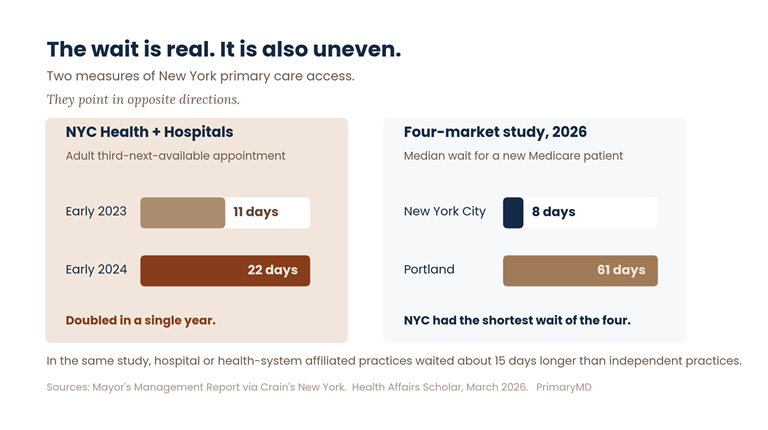
Read together, those findings say something more useful than "waits are long." Access in New York depends enormously on where you look, and for many people it is good.
For most New Yorkers, the harder problem begins after they get seen. A patient in Chelsea, Sutton Place, or the Upper East Side may be close to excellent specialists and still lack one physician responsible for the full plan. A patient in Boerum Hill or Carroll Gardens may be juggling care across boroughs, work schedules, school pickups, and referral networks.
Follow-up gets delayed. Preventive care shrinks into a checklist. Specialist recommendations pile up with no one deciding what matters most.
When is concierge medicine in NYC actually worth it?
Concierge medicine in NYC is worth considering when it fixes a recurring failure in your care. The strongest fit is a patient who needs one physician to organize access, results, specialists, prevention, and follow-up.
It tends to be worth a closer look if you keep running into these problems:
- You wait too long for answers when a new concern appears.
- You have multiple specialists and no one reconciling their advice.
- You receive test results in a portal without clear interpretation.
- You travel often and need continuity across cities.
- Your schedule makes delayed follow-up costly.
- You want prevention handled as an ongoing plan.
A membership may be less useful if you already have a primary care physician who knows you well, reviews results promptly, coordinates specialists, and gives you reliable access.
The real test is whether concierge care changes the process. A faster front door onto the same process is a smaller purchase than it appears.
What are you actually paying for?
You are paying for a different care process: more physician time, clearer access, result interpretation, specialist synthesis, preventive planning, and follow-through.
Longer appointments matter when they give your physician enough room to understand symptoms, medications, family history, sleep, stress, travel, and the practical constraints that shape real decisions.
Dr. Sukhjit Takhar, PrimaryMD's Co-Founder and Chief Medical Officer, often warns against "optimization theater": the appearance of serious medicine through dashboards, long lab panels, protocols, and targets without the clinical judgment that turns information into better decisions.
At PrimaryMD, we use physician time to understand the history behind the concern, select testing when it can clarify risk or change a decision, and review results against what came before. Before a visit, we review what has arrived since the last one. During the visit, we focus on context and priorities. Afterward, we document next steps and track them until they close.
- More physician time: Enough room to discuss context, risk, tradeoffs, symptoms, and priorities.
- Clearer access: A defined process for deciding whether you need monitoring, a visit, urgent care, or emergency evaluation.
- Ongoing relationship: A physician who recognizes changes over time and connects new concerns to your history.
- Result interpretation: Labs, imaging, and outside reports reviewed in context.
- Specialist follow-through: Outside recommendations reconciled and brought back into one plan.
- Preventive planning: Screening and risk review tied to your actual history and goals.
Pricing should be discussed plainly, and in the same units. Reported concierge medicine fees in 2026 run from roughly $1,500 to $5,000 per year for standard models, and $10,000 to $25,000 or more for executive tiers. PrimaryMD membership is $1,500 per month, billed annually, which is $18,000 per year.
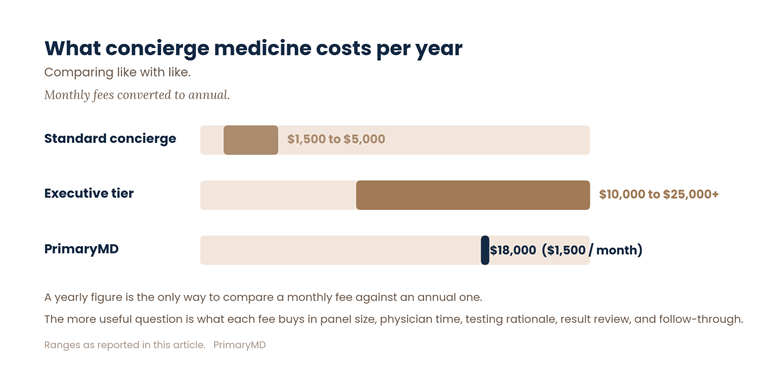
The useful comparison is what each fee buys in panel size, physician time, testing rationale, result review, and follow-through.
What does concierge medicine in NYC exclude?
Concierge medicine covers the primary care relationship and the services defined in the membership agreement. Patients still need health insurance for emergency care, hospital care, specialist fees, prescriptions, imaging, procedures, and outside testing.
Before joining any practice, ask three practical questions:
- What is included in the membership?
- What is billed separately?
- What happens when the issue is urgent, complex, or outside the practice's scope?
Clear boundaries are part of responsible medical care. A physician cannot safely manage every symptom by text. Some concerns require an in-person exam, urgent care, emergency evaluation, hospital care, or specialist input.
Who owns the next step after you reach out?
A strong concierge practice tells you who receives your message, who reviews it clinically, and who decides whether you need monitoring, a visit, urgent care, emergency evaluation, or specialist input. That process should be clear after hours, while you are traveling, and after abnormal results come back.
At PrimaryMD, your physician remains responsible for the clinical plan. Our partnership with Sollis Health supports 24/7 urgent care access, including member-only centers and telemedicine, and our physicians bring any urgent care episode back into your ongoing care plan.
How does concierge medicine compare with DPC, One Medical, and executive physicals?
NYC patients often compare concierge medicine with direct primary care, convenience-based primary care, and executive physicals. The labels matter less than the operating model behind them.
Dr. Takhar's recurring point is that better medicine arrives when a physician has enough time and context to interpret the data, decide what matters, and stay accountable for follow-through. More data by itself does none of that.
That standard is especially useful in New York, where more access can still leave a patient with no one clearly holding the whole picture.
Who benefits most from concierge medicine in NYC, and what should you ask before joining?
Concierge medicine in NYC often fits patients whose lives make fragmented care costly: executives, founders, attorneys, finance professionals, frequent travelers, busy parents, caregivers, and people coordinating multiple specialists. The best fit is usually about complexity, not status. Someone moving between New York and California, managing family logistics in Brooklyn, or juggling specialist input in Midtown may benefit from a physician who keeps the record coherent and follow-up moving. Patients with simple care needs and strong existing access may receive less value.
Before joining, ask what the fee includes, what is billed separately, who responds when you contact the practice, who makes clinical decisions, how after-hours or travel needs are handled, who reviews results, how specialists are coordinated, and what happens in urgent or emergency care. Strong practices answer with clear names, processes, timelines, and boundaries. At PrimaryMD, tests, scans, and referrals are recommended only when they have a reasonable chance of changing care, and we explain when testing makes sense and when it adds little.
So is concierge medicine in NYC worth it?
Concierge medicine in NYC is worth considering when the city gives you access to many clinicians and no one physician clearly owns the whole picture. The right membership should make care easier to use, easier to interpret, and easier to follow through on.
If your current system leaves you waiting weeks for answers, coordinating specialists alone, or interpreting borderline results without context, concierge medicine may create real value. If your current physician already gives you timely access, result review, specialist coordination, and follow-through, the case is weaker.
Every concierge practice in New York promises time and access. Ask who reviews your results, who reconciles outside recommendations, what happens after hours, what remains excluded, and who owns the next step after the appointment ends.
We built PrimaryMD around those answers. To discuss current New York availability and membership fit, contact our team.
Frequently Asked Questions
Does concierge medicine replace health insurance?
Concierge medicine does not replace health insurance. Patients still need insurance for hospital care, emergency care, specialists, imaging, prescriptions, procedures, and services outside the membership. A concierge membership strengthens the primary care layer, and it works alongside insurance.
Is concierge medicine the same as direct primary care?
Concierge medicine and direct primary care both use membership models, and they often differ in price, scope, insurance relationship, panel size, diagnostics, and coordination of outside care. Direct primary care is usually lower cost and focused on core primary care. Concierge medicine may include more extensive access, preventive planning, specialist coordination, and diagnostic review.
How much does concierge medicine cost in NYC?
Reported concierge fees in 2026 run from roughly $1,500 to $5,000 per year for standard models, and $10,000 to $25,000 or more for executive tiers. PrimaryMD membership is $1,500 per month billed annually, which is $18,000 per year. Compare fees in the same units, then compare what each one includes.
Is concierge medicine better than convenience-based primary care?
Concierge medicine may be better when the patient needs continuity, judgment, and follow-through across a more complex health picture. Convenience-based primary care may be enough when the main need is easier routine scheduling. The better choice depends on whether the patient needs simple access or ongoing physician ownership.
Is PrimaryMD accepting new patients in New York City?
We accept new members in New York based on current availability and fit. Please contact our team to discuss your needs.